Something Bigger

Free will and fate. I believe in both. I also believe in karma. Some of this is contradictory, but I’m willing to hold that contradiction because there’s a mystery to life that I cannot know. It’s like I’m standing in front of a gorgeous painting five miles high and ten miles wide but all I can see is the little part in front of me. Out of context, it might not make sense. It doesn’t fully convey what the painter meant. But just because I can’t see the whole of it doesn’t mean it isn’t there, doesn’t mean there isn’t meaning that I can’t grasp.

We all make choices. But there are only a limited amount of choices we can make. It is not true that you can “be” anything you want to be. When I was a kid I desperately wanted to be a singer. I can’t sing. I cursed God for yet another thing He withheld from me. It’s not an option for me to be a rock star or to be president. It’s not an option for me to own a mansion or manage a baseball team. But within life, I have my own choices and those choices create the circumstances where I experience life.

Every moment is where I experience life.

I believe in fate. Philip died because he snorted heroin but that isn’t the whole of it. Looking back at the way death touched both our lives, from the two-year-old who told me his dead grandpa was “in the light” to the way I kept seeing him dead in the months leading up to his death…and looking at what his death has done to me, it’s hard not to see a sort of “supposed to” as part of this. It does not feel entirely wrong that he’s dead, no matter how much I don’t want to accept it.

But there’s something bigger, more pressing, more to the point, because my circumstances are not the point. The way I think about them is. Whatever it is, the question is, What purpose does this serve? Take my job. I’m an administrative assistant, I’m the office manager. But that’s not who I am. It’s not what I do that matters, it’s how I am. Every day’s interactions are a chance to be present or to go to sleep. And I work for someone who is challenges me in this. The difficulty I have in responding to him shows me my real work which is way more important than what I get paid to do.

Last week my boss, Jack, was out of the office and called because needed something from me quickly. His abruptness unnerved me, and here’s where the present dissolved into the past, which means I went to sleep. I became the kid with the forbidding parents who couldn’t do anything right. I panicked because I didn’t think I could find what he needed, and after I did, I told him, “I’m afraid of you.” A few minutes later he called me back. “Look,” he said. “I don’t want you to be afraid of me, I want you to help me.”

Is this someone to be afraid of? I think not. But it’s not about him. It’s about the way my being is affected by him and how I’m going to work through it. It is the working through the difficulties in life, the being-ness that’s there when I do, that matters. A lot of that requires letting go of what I’m resisting to move more fully into life. And it is that letting go that I need practice because one day there will be a final letting go, and if I can’t let go of my boss’ impatience what makes me think I’ll be able to let go for the big one?

Death has lessons to teach us, and not morbid ones. Every time we stop resisting the circumstances of our lives, it prepares us that much more for death. And why not practice for that inevitable moment? Anything you want to do well takes practice. So why not practice what matters? A life lived without contemplating death is a shallow life. It’s made of up desire and accumulation of not only objects, but of people. None of which are real or sustaining, but a way of avoiding. I don’t want to avoid the fact of death, but neither do I want to continually feel like I don’t know how to live. Whatever I’ve come to understand since Philip died, the tangible ways he lets me know he’s around, doesn’t change the fact that I feel I like I lost a limb. Like I’m searching for something but I don’t know what it is. That there are times this still feels like a horror – did he really die, this child of mine? Will I really grow old without him?

Have I not yet learned that life is not predictable and any breath can be my last?

© 2015 Denise Smyth
Survivor Guilt

There are times when naming things creates problems. We name something, then we think we know what it is. I mean, I’m looking at my barn-wood six-foot bench that I use as a coffee table. In this instance, I can’t even exactly name it – is it a bench, or is it a coffee table? But what is it? It’s made from painted wood. If I was a scientist I might know the molecular structure of that wood. But that still wouldn’t tell me what it is. Things have an is-ness that can’t be named. If we didn’t name everything and then assume we know all about it, we might get closer to what that is-ness is.

We name “conditions,” too – we get diagnoses and begin to treat the disorder. Conditions have symptoms attached to them, and it’s not uncommon for people to think they have a condition and manufacture the symptoms to match it. I bring this up because it was suggested to me that I have “Survivor Guilt”. My reaction was to recoil, like, oh, please, that’s something other people get. I’m way beyond that sort of thing. Because sometimes my sense of cool still gets offended. Because I have a habit of wanting to be different. Like I don’t want to do death like the rest of the world.

It makes no sense to me, this Survivor Guilt. For decades I swore I wanted to opt out of this life. Swore I hated it here, that I didn’t belong here. I felt too much pain in this world, with not much peace to offset it. So how I could I feel guilty being here when Philip was wherever it was I’d been wishing myself to be for so damn long?

But what explains the way I short circuit when I notice I’m happy? And what does it mean for me to be happy? I’ve had a problem with that word since way before Philip was even a thought. It seemed silly. “Happy?” Like jump up and down for joy, like everything is okay? My philosophy was something like if you’re happy you’re not paying attention. Unhappiness gave me an edge – I saw things the way they really were. Happy was cheap and weak. Surface living. Naive. And not cool – definitely not cool.

As for guilt – for what? Guilt requires having done something wrong by choice. I felt so wronged by life I swore it wasn’t possible to feel guilt. Life should feel guiIt because It was indifferent to my unhappiness. I didn’t consider that if I felt life was beating me up, I must’ve thought I deserved it – hence, guilt. As far as feeling guilty about Philip’s death – it had nothing to do with me. There was nothing I could have done and I don’t make believe that there was. I’m trying to live with the reality of this, not a fantasy.

I had an idea about happy the way I had an idea about guilt. Thoughts in my head about what those words meant. I didn’t allow myself to feel them, either. I pushed those feelings into the background and let unhappiness be the foreground. But that rid me of nothing. It just let me not pay attention.

A couple weekends ago Natalie and I went to a wedding in Manhattan. My cousin was getting married, and my family was spending the night in a hotel. The ceremony and reception were held in a restaurant, and while the food was delicious, the service impeccable, and the bride a thing of beauty, the place was bathed with an eerie blue light and the acoustics required conversation to be loud and strained. The “dance floor’ was a tiny square with a DJ that had  two five foot speakers and a rough, ridged rubbery floor that stopped your shoes from doing what they really wanted to do. No matter – there were too many of us crowded on to it to move very much anyway. Who cared? We were in each others’ company to celebrate. So we did.

There were people there – family – I hadn’t seen in a long time. I forgot how much loved them, how much they loved me back. How are you, they asked? And I wasn’t sure if they were asking me how I was like everyone asks of someone not seen in a while, or if it was code for how are you since Philip died. God knows I wished they would ask that of me, but they didn’t. And I acted like that was what they’re asking me by answering with a slow blink and a pointed nod and saying, “I am okay.” I was letting them off the hook and was glad to do so. I’d no interest in making anyone uncomfortable.

Except that later, returning to my seat from the dance floor, I sat alone and wished I could cry to just one of them. They were laughing and talking the way I was laughing and talking. So where was Philip in all this? Did they think I forgot him? Were any of them thinking of him? Why am I so hungry for a witness to what I suffer?

Or did I just think I needed to suffer as a testament to my love for him? And if I think I am losing him in my moments of pleasure then what’s really going on is that I feel guilty that I could laugh while he’s dead. Survivor guilt isn’t what I thought – it didn’t mean feeling like I should have died instead of Philip. I’m not so arrogant to think I know who should be dead and who shouldn’t. What it is is the way I sometimes catch my breath when I realize I like what I’m doing or I’m enjoying the people around me and I stop it all to think, how could any of this matter when my son is dead?

The idea of Philip’s death is not the reality of it. The idea of it is that he’s gone and I cannot live in peace without him. The reality is he’s around me all the time. I have a relationship with him, the kind that matters – that of the heart. That doesn’t change, and what doesn’t change is what’s real. In other words, love. If we are not here to love, what can anything matter?

I have changed since Philip died. I have become more friendly. I smile more. I’m interested. In you. I think that happiness is a gift we give to others. My happiness is more about you than me, but if I can share it with you it’s because it is inside of me. I can somewhat handle happy in a more controlled environment. Like work. I’m all about helping, I’m cheerful, calm and steady. When I see a call coming in from someone I don’t want to talk to, I might sigh and roll my eyes but when I answer I am pleasant and helpful. And I’m okay with that until I hear my co-workers talking about their kids who are in college or have graduated from college and are flying off to new jobs and new marriages and I am reminded I will never dance at Philip’s wedding and that I can’t share with them the relationship I have with him now.

What do we owe the dead? Nothing, I would argue. They are past owing. To owe is to be obligated to – but if I believe I can’t be happy without Philip here, then I must think I owe him my grief. And my guilt. As if that’s anything he would want.

© 2015 Denise Smyth

When We Connect (Part 1)

“There are no rules for friendship. It must be left to itself. We cannot force it any more than love.”
William Hazlitt (1778-1830) British essayist.

A song I’ve recently listened to ends with the line, “There’s nothing in this world that’s holier than friendship.” I disagree. Try to define friendship. There’s a certain general meaning to it, but we each experience it differently. Some people are comfortable calling even casual acquaintances “friends.” What’s holy about that? Some people accumulate friends to fill a hole that only grows larger as they try to stuff it. Many try to be friends with the rich and powerful because it feels good to say you know someone who most of us have only heard of. And there are people like me, who are touchy and careful and scared to use that word. What if I call someone my friend and they don’t like me? I can only call you my friend if I am sure.

I’m going to use the word “soul” here, even though using that word other than in the context of, say, “food,” gives me the creepy crawlies. But it expresses a concept that I have no other word for. So when I say “soul” I’m referring to that holy, sacred, untouchable and often inaccessible place we experience inside ourselves. Simply put, it’s our better nature revealed.

Monday night I went to my writing group at Nancy’s house. We usually start with her reading something that’s caught her attention, a thing of the spirit. That night she read us someone’s take on what he called, “soul friends.” I had a conversation with Philip about something akin to this. Mom, he said, I know you don’t like the term “soul mate” but I have to use it. He told me that people have the mistaken idea that soul mates are romantic relationships, that they last forever. That can be so, but not always. A soul mate is someone who moves you deeply, challenges you, changes you in ways unexpected. And it’s not only through kindness and wisdom. You can have that connection with someone who moves you deeply, then hurts you terribly. It is the quality of the connection that determines the soul of it.

These relationships aren’t made. They are recognized. And that recognition reveals truths. The person in this world I am closest to, who knows me best, is Ed. I met Ed when I was about 40 and had gone back to college. He was my English professor for a Shakespeare class. He started the class sternly. He told the young men to remove their baseball caps. He went over the syllabus, laid out the rules. He talked about missing classes and missing assignments. Shit, I thought, this guy is serious. The he picked up Romeo and Juliet, walked out from behind his desk, gave a small, knowing smile and said, “Now. Let’s read some Shakespeare.”

That was my moment of recognition. I knew he was the teacher I’d been waiting for. Understand this had nothing to do with sex – it could sound like the older-professor-young-adoring-student thing, but that is a caricature of what I have with Ed. What I was after was his mind, his wisdom. I worked hard in that class, and continued to take classes with him. Our relationship developed over the years. It was simple and intimate. Ed knew who he was, and somehow, he knew who I was, too. He lived in Bloomfield, and when I moved from New York to Montclair I was a ten minute drive away. We began to spend more time together. I was restless and unhappy, but when I spent time with him my pieces all fit together. I used to joke that I wanted to move in with him. And I practically did, when Philip died. I’d spend long days with Ed and his wife, Franny. I’d sleep there, get up early to go home and walk my dogs, then go right back to his house. He was my home.

Then there was M. A writer, a poet. Someone I got to know through email, which is a story for another time. We had so much to say to each other, we were so easy together. He, too, felt like home and I fell deeply in love with him. At the time, he was my heart. That was my breakout relationship – because of him, I was catapulted out of whatever it was that bound me. I became a sexual being, I started to like myself because I saw myself through his eyes. When he left I was wrenched, but the gifts I’d discovered remained.

And, of course, my son. It is comforting to say that: my son. It reminds me how much a part of me he is – my son. He is unquestionably my soul mate. When I put my life together, look at it more as a whole, I see the unexplainable experiences I’ve had with Philip. Starting with the time I woke up in the middle of the night to hear the words, “You’re pregnant.” Next day I found out I was. And these things I’m talking about are too real for me to doubt my connection to him. When he was here, I felt how much he loved me and I do not easily feel love from the way I feel love for. He watched me, he paid attention. Such comfort I took from him. I didn’t have to call him or see him, I just had to think of him to feel the way he protected me. Kinda like the way it is now.

Philip is teaching me about death – and no one person has wrenched my soul as he did when he died. I saw Truth in all it harsh and terrible glory. But this theme of death was there from an early age. In the month Philip was to turn two, his grandfather died. I decided to take him to the wake. He has to know death, I thought. He shouldn’t be afraid of it. Getting ready for the wake, in my kitchen at our apartment in Brooklyn, I got down on my knees, took Philip by the shoulders, and said, “Philip, we’re going to see Grandpa Bill. He’s going to be lying down and he’s not going to get up. Is that okay with you?” I wasn’t sure how much he understood. But a little bit later, after I dressed him, then stood him on the kitchen table to fuss with his outfit, I said, “Philip, do you know where Grandpa Bill is?” With no thought or hesitation, he raised his arm, pointed to the ceiling, and said, “In the light.”

After Philip died, I went to the bedroom in the house he lived in to clean it out. I grabbed some of his notebooks to take home. Months later, when I felt ready to look at them, I found an essay he had started. His assignment must have been to write about childhood memories. He wrote a paragraph describing the apartment we lived in, then he wrote this: “When I was four, my parents took me to my grandpa’s funeral. At first I was scared, but then I saw everybody laughing and I felt better.”

He was not four. He was not yet two. But he remembered.

Stay tuned for Part 2.

© 2015 Denise Smyth

On Trust, Love and Death

Dee over at Always Remembering Amy wrote a post about trusting life that got me thinking. First a word about her. She is amazingly kind and compassionate – and she’s a giver. I love and admire this woman whom I’ve never met and probably never will. She knitted a prayer shawl for me, which I cherish; and when Pippin died she sent me a condolence card. She breaks my heart for her suffering. I wish I could take it from her but it’s not up to me to say what people should go through. I am not God.

I’ve never trusted life. I’ve lived in deep argument with it, like it was something outside myself, a dark and implacable presence hovering over me. Philip died when I was finally learning how to make peace with it. How to make peace with myself. The argument was being absorbed by a slow and steady knowing. When I stopped resisting I felt full and calm. Like I’d been an outline of a character in a coloring book that someone – that I – finally filled in.

That’s what Philip wants from me. That’s the work he meant I needed to keep doing when I heard him say, “Mom, you gotta go deeper.”

Life is benign – in that, I trust. I don’t think it “does” things to me because that implies I’m the center of the universe. I am not singled out – it’s not personal. Awful, horrible, terrible things happen to people all the time. Some of them we cause, some of them just are. Our worst tragedies involve death; but since death is an absolute, we need to find a way to reckon with it. I can say Philip shouldn’t have died, but who am I to say what should happen and when? Of course, that doesn’t change the fact of my grief. The way I think about his death creates the way I feel about his death. Sometimes I make it worse by telling myself I will never get out from under this. That is my monkey mind dancing in the graveyard. There is a difference between the stories I tell myself about Philip’s death and just feeling what it feels like to have lost him that way.

None of this means I think I don’t have trials ahead of me. “Trial” doesn’t nearly get at the depth of what I deal with every day because my son – my son – has died. Never have I known this kind of desolation. And I’m not safe from having more of it. I have a daughter – it is entirely possible that she, too, can die before me. Yet I don’t worry about Natalie – it’s not in my nature to do so, and Philip’s death hasn’t changed that. I am simply saying it because it’s true. If you think death is something you need to be shielded from, you will one day find there is no protection from it. So maybe we have to stop looking at it as the tragedy we feel it is.

We are all going to die. Every single one of us. How do we live in the face of that? You can spend your life worrying about it, you can try to acquire power, money, friends and possessions to avoid it, you can make every day count because of it.

Or, like me, you can be confused and unsure how to live with it and maybe make a hobby of withdrawing. At least for some of the time. I do well at work, am able to enjoy other people. I laugh when something’s funny. I love. But I also feel deeply alone and grieved and just don’t know what to do with myself. I mean that literally. I don’t know what it is I want to do when I have time to myself. I write, I knit, I mourn. But I’m restless and unhappy. I have a sense there’s some next step and I can’t see what that is or what it is that’s holding me back.

I need stay present to Philip’s death, which means not to resist it. It means gratitude for the connection I have with him, for his loving presence and the way it manifests every day. Except it’s difficult to remain there when a whole chunk of me feels gone, when I feel so deeply and irrevocably alone. When I feel like I need but I don’t know what I’m looking for. Maybe it’s because when I am not in the presence of someone I love, I lose all connection to them. Funny how I can remain connected to Philip who’s gone and died, but feel so distant from Natalie the minute she walks out the door. Every time I see her there’s a shock of love, a relief from my thoughts. You’d think I didn’t see her often, but I live with her. We spend a good amount of time together. She is who got me through the worst of Philip’s death, tending to me until I could begin again to tend to her.

There is only one thing that needs to change for me if I really want to find some peace. And that is my relationship to my thoughts. I am not my thoughts, I am the thinker of those thoughts. I can learn to recognize the background noise in my head and dismiss it, I can look at the stories I tell myself and change them. It’s believing the clamor in my head that keeps me bound and helpless.

Eckhart Tolle says it simply: “The more you make your thoughts and beliefs into your identity, the more cut off you are from the spiritual dimension within yourself.”

© 2015 Denise Smyth

Let It Be

When Philip was in high school, he was in the CGI program – Civics and Government Institute. Part of the core curriculum focused on learning how government worked. They’d do things like enact congress – the kids would write bills, present them, have them voted on. It wasn’t a program the kids tested into. If you were interested you applied, and as long as there was enough room, you were accepted.

At the end of the year there was a CGI dinner for the kids and their families. There would be a guest speaker, along with a question-and-answer period after the presentation. The year Philip was a senior the speaker was Andrew Rosenthal, editor of the New York Times editorial page.

I’m going to inject some politics, mostly for background. There was a time I was intensely political, followed the news and argued about it. Until I began to realize that the arguing was about being right and I was never right enough in spite of how certain I was that my “opponent” was wrong. Until I realized how deeply personal these national and global arguments really were. Take a position, identify with it and it becomes part of who I am. I can’t be wrong then, because if I am, I don’t exist. No matter how much worse than ever in history we think things are, how much more vindictive and out of control we insist the “other” side is, the fact is that we’ve been having the same argument over and over again forever. The content changes, but the form is the same. We write off most of the rest of the world because we’re so sure our side has it right.

And I think that when time comes to die, we will be comforted by how much we loved, not how much we were right.

The CGI dinner is not supposed to be political – it’s a family affair. Unfortunately, no one told Andrew Rosenthal. Obama had just been elected president, and a supremely smug Rosenthal started by telling us about his love affair with the new president, then went on to bash John McCain, made a sexist joke about Sarah Palin, disparaged Republicans in congress and then Republicans in general. He was playing to an audience of which I’d say 90% agreed with him. And you’ve probably figured out by now that I was part of the unpopular 10%.

Listening to Rosenthal, I was fuming. I leaned over to say something to my husband,  who replied, “You can’t be mad.” Really? Well, I was mad. That’s when I looked over at Philip’s table to see he was watching me with a smile. He put his hand flat out, palm down, about eye level and slowly lowered it. Smiling back, I mimicked him – his attention took the edge off.

If we’re lucky, we meet people in our lives who know us in ways most others don’t. They see us, they get us. And having felt invisible for so much of my life, I’ve been touched and grateful for those few who I’ve felt that connection with. Philip was one of them. It’s not because he’s my son – we can love our children like no other, but the connection I’m talking about isn’t a given with them. That kind of connection is a mystery. It’s either there or it isn’t, and when it’s there, we recognize it.

When I’m in the mood, I sit down and take dictation from Philip. It’s not odd or weird or seance-y. It doesn’t require candles or incense. It started as an exercise given to me from a grief group for parents I was part of after Philip died. I wrote about it here. And here’s a little story. After doing that exercise, I thought it might be something I should do on my own, but for a while, I didn’t. I felt confused about it – I didn’t know how to start. One day I was driving and thinking about it. How do I do this, Philip, I asked? Do I write a sentence, then listen for your response? Do I just sit and listen for you? Do I ask a question? As I was thinking, I stopped for a red light. I looked at the license plate on the car in front of me. Besides whatever numbers were on it, the letters there read, ASK.

So I had my start. One day when I was writing and listening, Philip started telling me about soulmates. Mom, he said, I know how much you dislike that term, but I need to use it. He went on to explain that people have the wrong idea about soulmates – they tend to think of them as romantic relationships, but that’s not necessarily what they are. A soulmate is someone who causes a deep and disruptive shift in your consciousness. And it’s not always in a kind and gentle way. I can think of three people who’ve caused that kind of disruption. One was the teacher I’d been looking for all of my life, and we are still close and dear friends. One opened me up by causing me what I thought at the time was the worst pain of my life. And then there’s Philip, this child I’m connected to like no other.

So why the struggle? Philip’s death purified that connection. He’s not in his body, he’s no longer an ego, he can’t disappoint, he doesn’t argue, he’s nothing but love. I’m closer to him than ever. He’s around me in ways that weren’t possible while he was alive. I am amazed and grateful for what he reveals to me. Why can’t I let that fill me more? I’ve written much about the ways I now experience him. Why can’t I let it all seep in, fill the holes and cracks I still suffer from his death? I’ve been flatlining lately, wanting to keep to myself, but so unhappy while I do so. Looking at Philip’s picture, the only feeling I can identify is resignation, defeat. He’s really – truly – not coming home and his loving presence gets lost from wanting to see him.

It just sounds so terrible to say Philip died. My stomach and chest still tighten to even think that. I’m still in the aftermath of his death, still experiencing the shockwaves. Still sometimes feel like I’m dreaming – like there’s something about this I’m supposed to grasp but I can’t. I still hold my breath – and if there’s something to “do” about this, maybe that’s it. Remember to breathe, send that breath to my chest, let it open my heart. Slow it down, let it be.

Since he’s really – truly – not coming home, maybe I can try to let it be.

© 2015 Denise Smyth

The Loop

Natalie’s birthday is the Fourth of July – she was born around 9:00pm, when the fireworks start, so I always say she came out with a bang. And that she did – she burst out and tore me open so my midwife had to stitch me up. What different births I had for these two who were born at home – Philip my winter child, Natalie, my summer. With Philip, labor was slow and steady, the pain mounting and tormenting. With Natalie the pain reached its peak quickly, stayed there longer. With Philip I couldn’t sit, with Natalie I couldn’t stand. With Philip my water broke before I went into labor. With Natalie, at nearly nine centimeters dilated, my water was intact. I can break your water and you’ll have your baby, my midwife told me. I was on my couch and thought I wanted to stay there; with Philip I wanted to be in my bed. Do it, I told her; I’m staying right here. So she did and then I panicked – I have to be in my bed, I have to, I told them. “Them” being my midwife, my friend Marilyn, my sister-in-law Ann, my husband. So Marilyn and Ann each took hold of an arm to walk me to my bed. I had a contraction on the way and would have collapsed but for them. Get her to the bed before this baby’s born on the floor, my midwife ordered.

When I started pushing Philip there was a period of relief from the pain; with Natalie it was relentless. When Philip’s head finally popped out, my contractions stopped and I had no energy to push. With Natalie my midwife told me to stop pushing but I couldn’t – hence she exploded into the world and then into my arms.

With Natalie, I needed stitches. With Philip, I didn’t.

I’d never known physical pain like the pain of childbirth. Nature makes sure we don’t remember it – we might know it’s awful, but we can’t re-feel it.  If we could, there’d be a whole lot less babies born. But that pain was nothing compared to the psychic pain of Philip’s death, which also – mercifully – can’t be remembered, at least not at that all-consuming, eviscerating zenith. I don’t know how I bore it. I can say the same about childbirth, but at the end of it, there was my baby. It’s been suggested that going through Philip’s death can become my own birth. I don’t disagree with that…but it doesn’t comfort. I’m certainly not the same as I was. But I’m not at peace, and it’s hard to imagine I will ever really feel okay. It felt hard enough to be here before he died. Three-and-a-half years later, I’m still mixing up grief with the deep unhappiness I had before. I have not learned how to get out of my own way.

Phil had a party at the house for Natalie on her birthday. My mom was there, my in-laws, a few of Phil’s friends, a few of Natalie’s. It’s what we do every year. This year, while I was there, I wandered into Philip’s room for a while. His two bureaus are now Natalie’s and are at my apartment – other than that, his room is as he left it. It needs to be cleaned up, it needs to be gone through. I looked through some things, touched his books, wondered what it would take to sort each thing piece by piece, to make decisions about what to get rid of. Three-and-a-half years later and I can’t imagine spending the time it would take to do that, nor can I imagine Phil making those decisions without me.

I don’t think I said a word about Philip that day. Except when I told Phil that I missed him. “Miss him” falls far short of what I really mean. There was a time I’d be upset because no one talked about Philip. Now I don’t know what I would say. I don’t even want to say. No amount of talking is going to bring him back, and I struggle to find the words for the magnitude of this. My silences both hurt and comfort. I still feel different, still don’t understand the world the way others do. I still sometimes want to say, Do you know my son died?? Yet I’m also glad not to talk about it, to hold this close and keep watch.

I’ve been in Philip’s room since he’s died, but this last time hit me hard. I’m stuck – life seems to have a sameness that’s difficult to bear. I look at Philip’s picture and see that “sameness.” He will never get older, never look any different. The rest of it – of life – is up to me. Lately I haven’t the heart for it. I do what I have to do, but enjoying myself isn’t easy. I read, I write, I knit – but I lose my concentration awfully fast, even if I’m trying to watch a movie or a show. I don’t want to go anywhere, can’t think of anything I’d want to do. I see Kirsten most Sundays and that’s one of the few things I look forward to. As well as when I spend time with Natalie. I feel better when she’s around, but she has a life of her own. And I’m grateful it’s a happy one.

I’ve talked of grief being a spiral, but lately it feels like a loop. Same thing, different day. And life’s been like a loop, too. I don’t remember feeling like this, not in a long time, and not since Philip died. That brings me to connection, which – in my last post – I said I’d be writing about, but haven’t yet. Feeling close and connected to others starts with feeling that way toward myself. Without that, I’m like a shirt that’s been mis-buttoned, each side missing the point. That’s why pleasure is absent, why the things that have sustained me through Philip’s death seem lost. I’m all body and no soul and to identify most with something so temporary leaves me restless and unhappy. As with all things I don’t want to feel, I ask, “What am I supposed to do with this?” Is there some action I’m supposed to take? Go out, exercise, call someone, take a trip, meditate? Wait, be patient, it’ll pass? I swear I’m missing some part that I can’t blame on Philip’s death, easy as that would be.

I just remembered something that I’d like to share here – it might be hard to come by, but even I can recognize joy when I see/hear it. Hope it makes you feel the same: Some joy to share

© 2015 Denise Smyth

Some Before, During and After

It’s over – we euthanized Pippin Thursday, June 25th. I’ve had pets before, but never from baby to death. My veterinarian, Dr. Katz (I kid you not)  eased us through the transition. She had a separate room away from the check-up rooms, on the opposite side of the office. The lighting was dim, there were sweet decorations around – like rocks painted by a friend of hers with angel-dogs and angel-cats. There’s what looked like a changing table with a blanket on it. We put the blanket on my lap and lay Pippin on me. Afterward, I would pick up him with the blanket and lie him on the changing table.

As soon as we walked in, the staff was ready for us. We were led directly to the room, followed by two attendants.  They explained the procedure, asked if we had any questions, asked how we were doing. There is no soothing like kindness, and they were full of it. They processed my payment in the room, before the procedure started, so we could leave directly when it was over. Neither Natalie nor I wanted his ashes – I think having Philip’s is enough. But we will be getting a paw print.

Then Dr. Katz’s assistant came in. Another kind, lovely woman. She gave Pippin a shot to put him to sleep. We were warned his eyes might stay open, and they did. Natalie and I sat next to each other, holding him, while he relaxed. Ten minutes or so later he was still somewhat awake, so he got another shot. A few minutes after that, Dr. Katz came in. She touched his face by his eyes and squeezed his paws – no response. It was time. She sat on the floor with her assistant, shaved a bit of his leg, found a vein, inserted the needle and then the drug. I thought I would feel something when he died, a lightness, a sense of something leaving his body. I didn’t. A minute or so after the injection, he was gone.

Years ago, when I first moved in with Nadiya, Pippin kept pooping in the house. It was a reaction to living in a new place, but it went on for too long and I thought I was going to have to get rid of him. Philip was living in a house by campus and offered to take him in if it came to that. He didn’t get him then, but he has him now.

When we left the office, Natalie leaned against a wall, bent over and sobbed. I rubbed her back and wondered why I didn’t feel the same. I had my bi-weekly therapy appointment that evening. My therapist said I was in shock. Okay. But I’m still not feeling much of anything and it’s more than a week later.

I don’t understand the magic of connection. It’s what I’ve been writing about for one of my next posts. You can’t force it. I love Pippin, but at some point I didn’t feel connected to him. He grew into a serious dog. He was always happy to see me, and I don’t mean he had a temper. Well, a bit of one. His idea of playing with a ball was taking it in his mouth and lying down with it, then growling if you came near. We tried to cure him of that – we’d force the ball out of his mouth and say, “no.” But nothing changed until he got older and didn’t care enough to take the ball in the first place.

We got Zoe when Pippin was six. I thought for sure he’d get excited – he was intensely interested in other dogs when we were outside, so I figured I’d get him one for his own. Plus I had this idea in my head that shih-tzus should come in pairs.

My neighbor Jim had a friend Elaine who raised shih-tzus, and gave me her number. It was around Christmas time, 2007. I called, Elaine told me she had a litter that she wasn’t showing until January, but since Jim was a good friend, she’d let me come and see. When I got there the puppies were toddling all around the kitchen – six of them, I think. I picked one up as I spoke to Elaine. Puppy put her tiny head on my shoulder and I stroked her. “You can’t pick one yet, she said. They’re young, and I’m waiting to see how their blaze comes in.” These were show dogs, and the “blaze” was the shock of white hair above their eyes. Then she looked at the puppy I was holding. Unless you want that one, she said. I can tell her blaze isn’t right.

Of course I wanted “that one.” I had to wait six more weeks to get her, sometime mid-January. By this time, Philip was 16, Natalie 14. I wanted to make Zoe part of Christmas, but not as a gift. I wouldn’t give a dog to a kid as a gift. They’re simply not going take care of them the way they need to be taken care of, and what happens when they grow up and leave? So I made a certificate that read, “This entitles the Smyth Family to one female shih-tzu named Zoe to be picked up in three weeks.” I put it in an envelope under the tree and had the kids open it last. They looked at each other, looked at me, and shrugged.

Yeah, I felt dopey, but I wanted that puppy and no amount of adolescent indifference was going to change that. Besides, wait til I got her home – who doesn’t love a puppy?

Pippin, for one. When he saw her, he gave a sniff and walked away. As the weeks went by, nothing changed. Sometimes when he looked at me I thought that if he could talk he’d say, “Really? I mean, really???”

Mourning is as it is. Grief knows its own mind. Pippin was hard for me. He had anxiety – he would constantly pace and start howling for no discernible reason. He threw up several times a week for years. He was serious. He had to be on leash or he’d wander away. And by the end he was deaf and blind, had to be carried anywhere you wanted him to be. It’s no wonder I grew apart from him. Zoe’s different. She’s so happy it looks like she’s smiling. She’s affectionate, gentle and her feelings are easily hurt. Sometimes I put her on my lap and talk to her, and she makes noises like she’s trying to say something back. She stays by my side, she looks for me. I can read her – something I couldn’t do with Pippin.

Connection. There’s so much to say about that. More, then, in my next.

© 2015 Denise Smyth

What’s Left

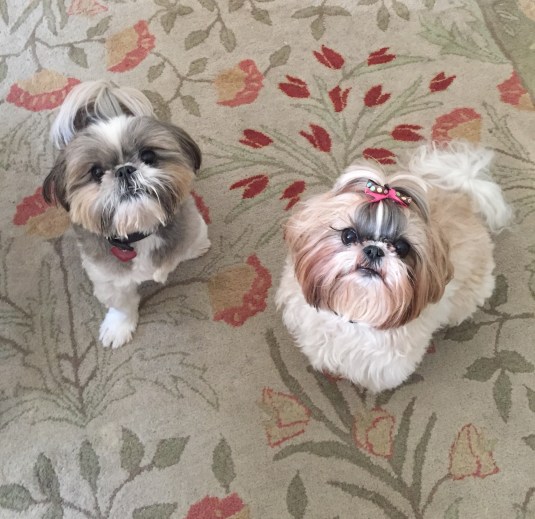
Pippin and Zoe, December 2014

Pippin and Zoe, December 2014

Death has a color, and for now it’s a washed-out gray blue – in fact, it’s exactly the color of the sky is as I write this, the 5:30 sky of a hot east coast almost-summer evening where it seems to be clear but if you look close, the blue’s shaded with a wispy, uneven layer of cloud. God, I hate this heat – the air’s thick with it, I’m sticky with it. I feel dirty in summer, my skin like flypaper that all things unseen cling to. I can’t get clean – whatever’s washed off in the shower is waiting for me when I get out. I don’t like summer, where I can taste the smell of rot and moving is slow and heavy. I feel fat in summer, feel like every fold of skin is filled with sweat, feel the food sit undigested in my belly, like it’s too hot to make its way elsewhere.

And the bugs – the huge mosquito in my hallway, the dining needle by the front door, the spider winding its web down from the ceiling, the creepy-crawlers crawling around as I sit on my front step trying to write this. It’s up to me not to let what I have no control over not bother me, but I’m not doing a very good job of it.

Maybe death took on this fading color because Pippin is fading and I have to decide whether to speed the process. When to speed the process.

I took what’s left of Pippin to the vet for his yearly checkup and shots. He can’t see or hear. He has chronic ear infections which makes him rub his head on the rug. Neither antibiotics nor the constant cleaning of his ears help. He’s on three medications for a collapsed trachea. He paces, he whimpers. My vet said it’s anxiety because he can’t see or hear. It’s like living in a tunnel. She prescribed anti-anxiety medicine and decided with all the meds he’s taking she didn’t want to vaccinate. He’s gained two pounds in three months – water weight from all the water he drinks? Enlarged heart? We can’t tell without further testing and he is not up to it. But his main problem is that his vision and hearing are gone – and there isn’t anything going fix it.

Go home, my vet said. Talk to Natalie. Write down everything that makes Pippin Pippin, see what’s left.

That’s the thing. He used to always have to lead when we walked. Now he won’t walk on leash because he doesn’t know where he is. He used to play with Zoe. He used to take a toy in his mouth and not let anyone take it away. He used to play tug of war. He used to like the dog park. He used to go up and down the stairs. He used to not bump into things. He used to not poop in the house. He used to wag his tail.

He used to greet us when we came home. Now he doesn’t even know we’re there. And when we go near to pet him – he jumps from fright. He doesn’t know what’s coming at him.

He becomes disoriented. I’ll bring him outside to pee, carry him down the stairs and to the lawn, where he’ll lie on the grass when I put him down. I try to stand him up and he sits. I’ll push him a little to get him walking, he’ll hunch down and refuse, sit right back down.

What an awe-ful decision to make. To be in charge of a death. I think of going to the vet and exaggerating his symptoms, so she’ll be the one who says it should be done. Am I then to live with that? If I think it’s time for him to die, then I have to take responsibility and decide. And I will hold him during the process; I will feel the life leave his body and that seems terrible and frightening.

It’s not uncommon to wish death for someone already sick and dying. It seems a relief for all concerned. Pippin is hard to take care of – thank God Natalie is taking care of him right along with me. So I think to myself, “Well, do I want his end so I’ll no longer be inconvenienced? But that wish is only part of the story. It’s tangled up with love for him and wondering how to prepare for what death takes and what death leaves.

And there is the voice in my head that Philip is asking me not to listen to. That voice focuses on one aspect of this and says I’m selfish and uncaring to even think of euthanasia. That I’m too lazy to care for him. My love for him, the fear I have of actually doing this – that’s lost in the stern, arms-crossed, head-shaking voice in my head that finds the worst and twists it into all that matters. It’s subtle, insidious and constant. I don’t notice it most times – it’s just the way I think. But when Philip says, “Let me be the voice in your head,” this is what he means. Why turn this into all-I-care-about-is-myself? Feeling that I want this over with is part of my humanity. As is the way I love him and the way I dread what I have to do. I mean, what would Philip say? Love him, care for him best as you can, look at what’s left and understand that the time has come.

***********************************************************************

This has been hard to write. I’ve been working it for a couple weeks. How to end, I wondered? What do I say, how do I feel? Yesterday’s visit to the vet was decisive. Tomorrow, 3:00, Natalie and I will bring Pippin to be euthanized. I’m numb as I write this. Makes sense, I think. Pippin’s still here, it’s all unreal. Being no stranger to death won’t make this easy; it will make it different. And as I said to my friend Pete, I’m okay now, but when I’m not – you’ll hear about it.

© 2015 Denise Smyth

Good Morning?

Ed has told me many times to go for the embarrassment. There is gold there, he says. And I am embarrassed about what I’m going to write, but I need to talk about it.

I work in a small office and all of us are around the same age. All of us have children around the same age. And for most of us, all those children are alive.

I can’t help but ache when I overhear my coworkers’ conversations about their sons. Of course I do. How grateful I am to have a daughter; I am that much less lonely. I love her deeply, and that love comforts. But one child cannot take the place of another. And when I hear talk of sons, my gut is like a magnet that pulls me in and away because I’m reminded it’s too sad of a world without Philip.

A couple weeks ago, Roger, Jack and Maggie’s son, came to work with us for a few weeks, until his summer internship started. Roger’s about 20 years old, tall and thin, just a touch of adolescence awkwardness left – a chest that still needs to fill out, calves that are thin and haven’t fully taken shape. Philip had just been past that stage, had come fully into his body. I remember his ascent into manhood, the shock of a hairy calf showing out from summer shorts that reminded me my child was no longer a child except in my heart.

I am an assistant. I do what I’m asked, and sometimes – rare times – there are personal things Jack and Maggie need done. I’ve been asked to do things for Roger. Cancel his gym reservation, try, and try, and then try again, to change his plane reservations during a time it was impossible to do so. And sometimes I have been resentful. I am doing things for this young man, this son, that I can never do for my own.

Watching Jack and Maggie tend to Roger when I can no longer do that for Philip – well, the loss of Philip’s physical presence overwhelmed in ways it hadn’t for a long time. I was reminded of the deep, deep bond that is family, the same bond that I know I still have with Philip – but to witness it in the flesh was devastating. I was back to crying in the bathroom, crying off the makeup I’d so carefully applied in the morning. It got so I had to heave myself out of bed from the psychic weight I was carrying.

And then this, because when I am in a state of loss, I know exactly how to turn the world against me:

Jack and Maggie are wealthy. They are also kind and unpretentious. But what I do in those dark and creepy places in my mind is equate all they have and all they give their children with their inherent goodness. Because I have less, I become less. That Philip died becomes a testimony to my inability to be a good mother and I feel shamed and cheapened.

Of course I know better. I’m at a point where I’ve never wanted less. I need to keep it simple. But this isn’t about mortgages and bank accounts. This is about having a dead son to whom I can give nothing. This is about me equating fiscal worth with spiritual worth which I thought I was long past, but apparently am not.

My co-worker Sandy works in the office next to mine. He’s there when I arrive, and every morning I stick my head in and say, “Good morning.” It took me a while to be able to do that – I’ve long wondered what was so good about morning when it’s the dark of night I crave. No matter. “Good morning” wasn’t about me. It was a gesture that felt good to make.

There are two desks in Sandy’s office, and Roger’s been sitting at one of them. The first few mornings I saw him there I walked past without a word. I could not speak because my stomach somehow made its way into my throat. I would’ve been ashamed except I was too busy feeling lost and invisible.

There’s not much of a happy ending here. But there was coming to reality. There was me finally able to speak to this young man, to make him into a person and not just a son. To “good morning” him every day because it felt better to do that than not. To create space to breathe where I was holding my breath. But how much grief in that space, how much sorrow.

I’m better, but still thrown. Grief’s like the ocean – the waves come in, the tide goes out. Sometimes it’s a gentle wave and I keep my sea legs, sometimes it’s tidal and knocks me out. And thank God sometimes the tide’s so far out I think I can bear this. These couple weeks were a knockout, for sure, and the psychic shift lingers. Could I have responded differently? Could I have said, oh, I am sad, I miss my son, I want him here because I need his hug and just let myself be? Where does that racket in my head come from, and how do I make it shut up?

I could start by listening to Philip, which I forget to do when I’m that low, the time when I need to listen most. “Let me be the voice in your head,” he says. Let me be the voice in your head.

© 2015 Denise Smyth

There Must Be

“There must be another way.”

(NB – on 5/29 I updated the links to A Course in Miracles, as I’d mistakenly put the wrong ones.)

And so began the birth of A Course In Miracles, the origin of which is as fascinating as the course itself. I won’t go into it because out of context it can be an eye-roller. I read the story of how it came to be as I was reading the Course itself – and though skeptical, I decided it didn’t matter where it came from or how it got here. It spoke Truth to me and that’s what mattered. And I’m talking about the serious Course in Miracles, not the watered-down Marianne Williamson version. I think she’s helped bring the Course to the attention of many; but I also think to begin to understand what it’s saying, one needs to turn to the Foundation For Inner Peace for help.

The Course is combination of three books – the text, the workbook and a manual for teachers. The workbook has a lesson a day for a year – I did it, but it took me much longer. Some lessons I lingered on, some days I skipped. If the purpose of the Course can be summed up in one sentence, “There must be a better way” is it.

If the Course taught me nothing else – and it taught me much – I came to understand that it is the way I look at things that creates my feelings, my very life. When something happens, it’s a fact – I perceive that fact and make a story. Like this: I’m driving to work, I hit the curb, my tire goes flat. I’m furious. I’m going to be late for work, I have to call AAA, I have to wait for them for God knows how long. I want to blame someone but there’s no one to blame so I blame myself for being a shitty driver, I blame the town for making the street so narrow.

So is the truth of this is that it’s a calamity? If I look at it from AAA’s view, it’s not a problem – it’s their job. If I look at it from my boss’ view, he knows I’ll be a late for work and he’ll go back to what he’s doing. I can sit and fume, but for what?? If a flat tire is inherently a calamity, then it must be a calamity for all. So if there must be another way to see this, what can that be?

I have a flat tire. I am not helpless. If I have to wait I can read or listen to the radio or sit and pay attention to where I’m at. I have discovered that when I give my full attention to whatever it is, I become interested. When I make room to breathe, the anxiety dissipates. And it’s not theoretical – I know what it’s like to sit and wait for AAA and I have spent the time enjoying it.

So you start with the small things to see how it feels and you come to see that that is the way. Then your kid dies and it all goes out the window because all you can think is Really? See this differently? Are you FUCKING KIDDING ME??

A  miracle, simply put, is a shift in perception. A Course In Miracles recognizes no difference in the degree of difficulty of that shift. But it takes major practice and willingness to see that other way. I say I want to feel better – is that so? When I think of my son dead, I have to wonder how much “better” I really want to feel. I am not talking about anything like “moving on” (the mantra of the unconscious and uninitiated) or forgetting. I am talking about my ability – my willingness – to join with life in the face of this most torturous death.

To see Philip’s death differently is to separate my riven heart from my shrieking mind, the mind that takes haunted voices from a troubled past and lets them speak of that which they know nothing about. My heart needs to put words on what this is because my heart doesn’t lie. I just need some quiet and patience to listen. And I’m not doing this alone. When Philip said, “Let me be the voice in your head” he was asking me to let him help me see things differently because that is the answer to the question, what can I do?

For months after Philip died I relived the moment I found out – the phone call telling me Phil had come, the knowing without another word being said, screaming down the stairs, crawling on the floor; My son, my son, my son my son. Over and over I would think about how I flew down those stairs, making myself sick and dizzy until one day I heard Philip: Mom, you don’t have to do that. Of course I didn’t. All I was doing was jackhammering my already raw and bloodied heart. So there was one, clear thing I could do. When I found myself on those stairs, I brought myself back to where I was, gave my attention to my surroundings. I tried to stop telling that story because my stories take me from life, which is only ever happening in the present.

What I’ve never been able to reconcile about “living in the present” is that Philip lived and died in the past, so am I supposed to forget?? But I think I’m starting to understand. It’s the past that’s gone, not my son. The past is memories of moments in time, and every moment in time becomes but a memory. Every word I write was a thought in my head a moment ago. Every moment is new until it isn’t. The future comes only as the present. And while Philip’s death can make my my life seem too long, when time comes to die I’m going to feel like it all went really, really fast.

Turning to the present from the dream of past doesn’t mean I leave Philip. He is not here as I want him to be and he’s not going to give me the future I had in mind. Such is my sorrow. But he is my love, my heart, my guide, my muse. He is here and he makes himself known. There are times I rest in that knowing…and there are times when it just isn’t enough. And too often lately it really isn’t enough. Next time I’ll talk a bit about why.

© 2015 Denise Smyth

Previous Older Entries Next Newer Entries