To Sit Quietly

Natalie's Birthday

Natalie’s 21st Birthday


“All of humanity’s problems stem from man’s inability to sit quietly in a room alone.”
Blaise Pascal

In “True Detective” there’s a scene where Marty, angry with Rust’s take on things, tells him to “stop sayin’ shit like that.” Rust answers, “Given how long it’s taken for me to reconcile my nature, I can’t figure I’d forego it on your account.”

It’s things like that that fascinate me. Rust is cynical, aloof. He’s a self-proclaimed pessimist. He has no friends, and the only relatives we hear about are a mother who might or might not be alive, a father he didn’t get along with when he was alive, a daughter who died when she was two and a wife he’s divorced from because of it. He thinks existence is a mistake and the best thing we could do is stop reproducing, and so “opt out of a raw deal.”

Awful as any of that sounds, he says he’s reconciled his nature. “I know who I am,” he says. And what fascinates me is the idea of  knowing who I am and then allowing myself to be, even if I don’t look the way the world says I’m supposed to. But is that “self” knowable? Is “who I am” something other than fluid? Is “who I am” anything more than some self I’ve invented, and then judged?

Sunday we had a party for Natalie’s 21st birthday. Her birthday is actually July 4th, but she’ll be away in France so we had her party early. I made dessert, like I always do; pie, cookies and a sheet cake decorated to look like a flag. And like every day – which is something that I’d been starting to grasp right before Philip died – it wasn’t a good day or a bad day; it was a day of moments and some felt better than others.

Natalie is now (or at least, in 9 days will be) as old as Philip was when he died. Last year, when she turned 20, I spent some time feeling sick and scared because it hit me she was no longer a teenager, that she was “catching up” to him, which seemed to make him more dead. How will I feel when she turns 21, I wondered? On Sunday, I felt nothing in particular that I could connect to her birthday. Since then, whatever mood I’ve been in, whatever dark places I’ve been banging around in, I can’t connect them to Natalie’s turning 21. And I know that no matter what, Philip will always be her older brother.

At the party, I spoke to my sister-in-law J. for a while. She told me that when she was looking at cards for Natalie, she saw one with a big 21 on the cover. “I couldn’t buy it,” she said. “It didn’t feel right.” I’m sorry I didn’t tell her what it felt like not only to know she was still thinking about Philip, but that she told me about it. I told her that I just felt done; that I’m always feeling that I’d rather be where Philip is than be here, even though here is where Natalie is. I feel bad saying that, I told her. But my grief feels so much bigger than wanting to live ever could.

But is it true that I “always” feel like that? I don’t “always” feel like anything. Last week, I was asked to find a plumber for a job we’ll soon be starting (reminder: I work for a design and construction company). The job’s in an area we’ve never worked in, so we need to find subcontractors. So I googled “plumbing contractors” and that’s where I found Doodyman. In fact, what came up was not just Doodyman – it was “Doodyman to the rescue.” I was thinking, gee, poor guy, how hard to grow up with a last name like Doody, how fortunate he became a plumber – until I went to his site where there’s a Superman figure with a toilet bowl on his chest instead of an “S” and he’s talking about unclogging this and unclogging that and how he’ll make you “doody-free” and there’s even link to “The Adventures of Doodyman” and I realized, well, duh, it’s a schtick, not a last name.

I found this hilarious. I mean bent-over-belly-clutching-wiping-tears-from-my-eyes uncontrollably hilarious. I haven’t laughed like that since Philip died. And every time I told someone else I lost it again and I don’t think anyone was laughing at old Doodyman as much as they were laughing because I was.

So what was it I lost? The voice in my head. The voice that creates my-self so exquisitely that I can’t tell which came first, this terrible self that deserves what it’s being told or the secret, brutal voice that assures me my daughter can love me, my friends can care about me and I can do as well at work as I want, but when I come home and sit alone with myself there’s an ugly truth to being alive that’s always been and always will be, and if I want proof of what that is, it’s that Philip’s dead. And his death becomes real personal, the antithesis of what I wrote here.

I’m told life is in the living. I’m here, Philip isn’t, but I have to go on, make a life for myself. Philip wants me to be happy. I’m told I should be happy that Natalie’s going to France, I should be proud that I’ve raised a kid who’s moving out into the world. She’s also found an apartment, and chances are she’ll be moving out when she gets back. I’m not losing her, I’m told. She’s still here, she’s in my heart. Like Philip’s in my heart. Like that’s a comfort – and maybe it should be, but right now, it’s not.

I can’t be logical about Philip’s death. I do go on. I love my daughter; when I see how happy, scared and excited she is to go away, of course I can join her in that. But be proud that she’s leaving? That’s what kids do. I could be a shitty mom, I could be mom-of-the-year; kids leave. What’s to be proud of? She should be proud, for all she’s accomplished, particularly these last few years. I didn’t need her to do any of that to be “proud” of her. I love her; that she is, is enough.

Philip’s dead, Natalie’s leaving. Ed’s moved. I feel diminished and that makes being alone a tortured and terrible place to be. Alone’s where I read, where I write; where I sew, and where I cook. I can’t do what I love without alone-time. Except alone is like being with three people – the one who’s vicious and abusing, the one who feels deserving of abuse, and the one who’s sitting here writing about it. How the fuck am I supposed to sit quietly in a room with that??
The Wanting

I don’t know the world since Philip died. Sometimes I think I’m just dreaming it away. But I try to pay attention to the light, what I hear it saying when I see the way it hits the trees. I’m cautious with morning light – it’s full of promises it can’t keep, has a brightness I don’t understand. What’s it so happy about, what’s it looking forward to? Morning light means adjusting – again – to time without Philip. I’m pissed at the afternoon light. That’s the light that’s turned against me – the trees catch fire and motion stops. The world’s suspended for hours in its harshness. But then there’s the evening light –  the softening of the day, and the lovely word for its waning: the gloaming.  Evening light is warm and rich and I’d like to slide right under it and stay there. Let it close in on me, let it wrap me in its luscious velvet and then maybe I can stop thinking.

***************************************

Match.com, story number two. Michael. Nice guy, interesting, handsome. Stud in his ear, which I find sexy. Suggested meeting at a yoga class. Skin-tight yoga clothes on a first date is a risk. I took it. And I liked it. After, we went to a cafe, talked over sandwiches full of whole-grain goodness. The bill came and Michael shook his head when I reached for my wallet. It’s the kind of gesture I want a man to make. Then he walked me back to my car. That’s the crucial moment – it’s either “let’s do this again” (said casually so you don’t sound too eager) or “I’ll be in touch,” (which means s/he won’t.) I let him decide because I was ambivalent. “I’d like to read your blog,” he said. I gave him the address. Then he handed me his business card and said to email him.

Sounded like a “let’s do it again” to me.

“Ambivalence is not nothing,” Philip tells me. I try to work with that. I’m often ambivalent because I don’t know what I want, I don’t know what’s driving me. Or stopping me. So while I didn’t particularly care whether or not I saw Michael again, I decided any decision was better than no decision. Next night I wrote him a short email, ending with, “So now that the first awkward date is over, if you’d like to get together for a second semi-awkard date, let me know ;o)”

I never heard from him. And other than being a wee bit stung by his rejection, I didn’t care. Since Philip died, I’ve never more known that the way people treat me has nothing to do with me. Even on a date, that intensely personal time with its concomitant judging. Someone not wanting to see me again isn’t personal.  What’s it change about me, if someone doesn’t think I’m second date material? It just means he realized we weren’t right together before I did.

I was listening to a podcast with Natalie about a man who, because of some temporary condition, lived with no testosterone for a few months. I had no desire, he said; none. He’d sit and stare at a wall for hours at a time. He didn’t want to read, or watch TV. He didn’t care what he ate. Yet he could see things were beautiful – in fact, he thought everything beautiful – but he didn’t want. Did I feel like that when Philip died, drained of anything I ever thought mattered? No – what I felt was way too wrecked and crazed to have lost all my wanting. I had no desire to bathe, wash my hair, go out, dress in anything but pajamas; and makeup – you’re kidding, right? But I had piercing desire, wanting either Philip to come home to me, or me to go to him. I was beyond reason.

In spite of the fact that Philip died, the world continued on its way. Eventually I had bouts of no-desire, lying on the couch in a state of One Huge Shrug. It wasn’t Zen-like, the way the guy on the radio described it (not that this guy ever wanted that to happen again). It was depression. For the most part, it’s not like that now. I want to write, to read, to watch TV; I want to knit and sew. I want to buy clothes. Partly because I’m not done being vain, partly because the way I dress draws attention, and if you can’t see I’m different and branded because my son died, I’ll wear my difference so you’ll notice something. “Hey – what a cool top – where’d you get it?” “Free People, do you know my son died?” “I didn’t know bell bottoms were back in style.” “Then you’re not paying attention, do you know my son died?”

As far as desire for a man…I must’ve wanted something beyond stories when I put myself on Match.com. But whenever it comes time comes for a date, I shrink. When I’m home with my writing, my books, my computer, my TV, on my couch that needs to be replaced in a living room that still has no curtains, I see no reason to invite a man into my life. I’m still nursing my grief. Working full-time and seeing friends just a little bit more than I used to gives me less time to do that. Something tells me if I let a man love me, it would be good for me; something also tells me I’m not emotionally up for what it takes to get there. I’m drained and vulnerable from living with Philip dead, and I’m not so sure about putting myself in the path of desire. Because really – it’s the wanting that undoes me.

© 2014 Denise Smyth

It’s My Heart

I haven’t felt as blocked and listless about writing – which is to say, about living – since I started this blog. I’ve been writing a post for a week, and I’ve got the bones of it. That’s usually when it starts clicking, when the writing starts writing itself. But the writing can’t “write itself” if I don’t show up for it. And I can’t seem to do that.

Ed moved. For the twenty year’s I’ve know him, Ed’s lived in Bloomfield, and ironically enough, when I moved last August, I moved close to him, close like a good, long walk away. But he and his wife had enough of working their house. They left it a buyer’s dream. I’m happy for them, that it sold quickly; but that house had been my sanctuary when Philip died. I spent days and nights with Ed and his wife, waking up early to go home and walk the dogs, returning a couple hours later to the only place I felt safe. Now they’ve moved to Florida, where they’ll stay for a year before coming back to buy a second home in New Jersey – something smaller than their last, something farther west, something that at least will be driving distance away.

So it’s not that “bad,” if you will. I can fly to Florida to visit, then they’ll be back before I know it. And If I’ve learned nothing else from Philip, it’s that when someone’s in your heart they’re with you always – you just have to accept it the way it is, not the way you want it to be. I keep saying that every change is practice for death. The practice is the leap into the unknown, the risk of not resisting what’s so. If I can’t handle the changes in my life now, how am I going to handle that last big change, that final slipping into the unknown? I’m kidding myself if I think I can stay miserable about my losses, yet go gracefully into that Good Night.

I’m mourning. I’m withdrawn. I’ve been depressed, which is different from sad. Depression seeps – it’s a whole, big, generalized “what-for-what’s-it-matter?” Growing up, I felt alone and tormented. I looked to death as a way out – at least, to my idea of death, which I imagined as a release from pain. But Philip’s told me that thinking death is some kind of answer is the same thing as thinking hitting lotto will make everything better. It’s the same in that it’s thinking some event in time, some situation other than the one that is, will be a cure. It doesn’t work that way. And I watch the way I’m responding to life, knowing so much of this heartache is about Ed, but unable feel it that way. I’m disconnected from the source.

When Philip was alive, he’d become my center. A cure for my unsteady. The older he got, the more I let go and the closer we became. But no matter what was between us, while he was alive I wouldn’t have had access to his wisdom the way I do now. And that’s because when we’re alive, there’s a lot of ego-noise that interrupts the flow of what we’d otherwise know to be true. Things like greed, power and desire, which have to do with the body. Philip’s gone from his, yet I experience him clearly and continually. Which doesn’t mean I don’t grieve for him incessantly.

A couple weeks ago, I joined Match.com. Last week, some guy named Steve sent me an email. Good looking guy, says he’s a trial lawyer, says he does stand-up comedy in NYC, when he can. His letters were funny enough that I believed him. He started his email by stuttering about how  b-b-beautiful  h-h-he  t-t-t-thought I w-was, then launched into funny bit about about where he lived, how he liked my profile, how he’d like to hear from me.

I was smitten. ONE email, and I was smitten.

So I answered him and he answered me and I answered him and it’s all funny and I’m feeling warm and fuzzy. And while I was feeling that warm-fuzzy, I thought of Philip, saw him in lying in the coffin. That’s when I heard him: “Mom,” he said, “You don’t have to choose.” Because that’s what I do. I can’t figure out how I’m supposed to live without him and feeling a certain kind of pleasure just seems wrong. He’s trying to tell me it isn’t.

As for Steve, he was the fantasy guy. The one that makes it seem like it’s so easy because that’s what he does. It was like shooting up pleasure. I mean, it was all about me – he saw how lovely and beautiful and special I was. Hell, he “snuck out of court” to write me!  He made it easy to slip past the goddamn anxiety of real-world dating. But like any fantasy, eventually you wake up. And I don’t mean like Sleeping Beauty, when you find The Prince has been waiting for you. I mean like when your second email doesn’t get answered and the guy hides his profile so he’s inaccessible and it hits you that maybe Prince Charming has a heavy hand when it comes to Cut and Paste.

Two emails was all it took for me to plunge into the netherworld of disappointment. I spent all that Saturday lying on the couch watching “True Detective” for the seventh time. I stopped for half an hour to take a quick drive to Ed’s for a final good-bye. Watching him direct the movers was too much. “I have to go,” I said. “I’ve had enough.” “I know,” he said. “I love you.”

So who the hell was I mourning for, really? For two-email Steve? I think not. I think it ironic that the weekend Ed was leaving was the weekend I let myself be seduced. I used to think that with Philip dead, what the hell could ever bother me again? Now I think that because Philip’s dead, many things bother me more. Prometheus was tied to a rock. Every day an eagle came to peck out his liver, every day it regenerated so the eagle could come back and do it again. It’s like that, except it’s not my liver. It’s my heart.

© 2014 Denise Smyth

Getting It Right

I’m steeped in a past where the details get blurry. I’ve been trying to write a post about the few days after Philip died, but I couldn’t remember how it went down. I called Austin, Philip’s friend, who I haven’t spoken to since Philip died. He was there in the aftermath. So now I have it clear. Except for one thing. I forgot to ask – was it Tuesday and Wednesday, or Wednesday and Thursday, or Tuesday and Thursday? I am not kidding. The “scene” involves one of these pair of days so how can I write it if I’m not sure? Call Austin again? He’ll think I’m crazy. Why should I care? It’s not like it isn’t true.

As a non-fiction writer, my responsibility is to tell the truth. As a narrator, I want to be reliable. As a human being, my memory is what it is. As a mom, I need to make Philip visible. I’ve a hard time accepting that maybe something didn’t happen exactly as I remember it. I work hard to get it right, to get you to see what happened. I don’t believe “creative nonfiction” means making up things that didn’t happen to fit the narrative of what did. Creative nonfiction is story-telling, with the obligation of telling it true.

Of course, who’s to say what’s true? We all know the phenomenon of, say, five people witnessing an accident and getting five different accounts of what happened. But that’s not a mystery. Our minds are a locked box. No one gets in there but us. What we see has to do with what we’re looking for. So if I look for death, when I see an accident I’ll go for the gore. If you look for life, when you look at that accident, you’ll look for who’s left standing. Of course, it’s all way more subtle than that – and it’s in those subtle ways we create our reality.

I’m writing the story of living with Philip’s death. What happened, what’s happening, how it all feels. I am trying to get at something, something that’s eluding me. Writing’s the way there. Writing stops me, forces me to breathe, to put form on the formless. But when I can’t remember something, anxiety forces me from the keyboard and to the internet where maybe I’ll shop for things I won’t buy or bookmark recipes I won’t cook. I think writing’s a way to get control over some aspect of what I really haven’t any control over. If I can’t get it right, I panic. If I can’t get it right, I lose a piece of Philip.

I think the holy act of writing is going to absolve me of something. Getting it right is Philip’s resurrection as well as my redemption. If get it right, Philip will still be dead, but at least I’ll have been a good mother. And there’s my karmic circle. “Getting it right” is another something outside myself that’s going to rescue me and pushing the “publish” button 83 times hasn’t cured me of that. It’s an impossible end, this Getting it Right. Because there isn’t any end. No matter what it is, there isn’t any end. Death included. Philip “died,” but he isn’t gone. And I’m not talking about his constant signals. That’s part of it, but there’s the fact of all the people he’s touched and continues to touch, the way we love him, remember him, live with his spirit. There’s me, writing about him, sharing him with those he’s never met. Dead has to do with body, not with what really matters.

But then, isn’t getting it right what drives art? That need to create so we can share our vision, to have others see as we do? It’s that need that keeps me writing, it’s that very getting-it-right that slows me down enough to get familiar with what still feels like the hole where Philip used to be. And that hole doesn’t get filled. It gets lived with.

And so I fret. Was it Tuesday and Wednesday…Wednesday and Thursday…Tuesday and Thursday…

© 2014 Denise Smyth

It’s Simple. Ask.

Sunday morning I woke up in a motel room with Natalie in Wildwood, NJ. Phil was in the room next door. We were there to watch Natalie compete in the annual NJ State Competition for gymnastics. Natalie’s been a gymnast since she was five, been competing since she was ten. This was the first year Phil came to States. It was the first time my in-laws came, too; Phil’s brother with his wife and two kids; his sister and her husband.

They all showed up because this was Natalie’s last meet. She’s outgrown her time at the gym. The last of the kids she’s close to is graduating, leaving for college. For Natalie, the sport includes the friendships that come with it, friendships that will hopefully last a lifetime. But it’s time to move on. We left Sunday knowing we wouldn’t be coming back. And I was feeling the loss particularly because it was Mother’s Day, and not because she’s never coming back to me,  but because another phase in her life  – in our life – is over.  “I’m trying to think – did I ever miss a meet?” I asked her; “There must’ve been one I didn’t come to.” She shook her head. “None,” she said. “You always came.”

She’ll practice, for fun, for the next month. Then July 1st she’s off to France for five weeks. The longest time she’s ever been away from me, a tiny taste of what’s to come. And I suppose I shouldn’t be upset because losing her to a life she loves living is far better than losing her to the alternative.

Yes, I know. I’m not “losing” her. But fuck all if that isn’t what it feels like. Today I’m angry, I’m mournful – I’m hungover from the crazy that was Mother’s Day. What’s any of it for? Life is loss and in my better moments I know there’s also what’s between the loss. Thing is the loss hurts more than the joy that having brings. Philip’s death has marked me. I’m branded and apart and I want something for it. What? Some recognition? Acknowledgment of how hard it is, as if I don’t get that anyway?

It was hard being around my in-laws. Leaving a marriage breaks up a family, each in its own way. I’m not sorry for my choices but that doesn’t make it easy. Sitting there Sunday, hearing bits and pieces of conversations that no longer have anything to do with me, added to a lonely I love to get lost in. And I was angry that none of them mentioned Philip, no one acknowledged I have two children, that the child who first made me a Mother died; that all anyone said was, “Happy Mother’s Day!” like it didn’t mean something it wasn’t ever supposed to mean.

But what do I know what anyone was thinking? It’s hard for people; no one’s sure what to do, what to say. It’s easier to say nothing. Grief throws people – certainly no one more than the person who’s suffering it, but also those on the edges of it. Would I have known what to do with someone’s grief before Philip died? And it’s not that I “know” what to do as much as I’m not afraid to ask. I understand the need to be asked. What more caring thing could someone say to me than, “How are you? How has it been for you?” And why is something as simple as that so hard to say?

Sunday night, after Natalie and I got home, I went out with the dogs, found a bench in a field and sat and cried for a good long time, cried like I haven’t in a while. I wanted some stranger to come by, ask me what was wrong. I might’ve had more luck with that on the busy corner of Broad and Watchung than in a dark and deserted field. But I think I was digging myself in deeper, drunk on grief and pity. And I paid for it these last few, terrified of losing Natalie’s love because how could she care for a thing as low and pitiful as me?

Last year, on Mother’s Day, I wrote a post called, “Still the best day…” Who is that, I thought; who is that calm and thoughtful woman because I feel too crazy to think it could have been me. But it was me. Grief is not linear. It’s not a march forward – it’s not even a “one step forward, two steps back” thing. Its nature is cyclical, but truth is it’s a spiral, deepening even as it goes round and round. Crazy’s part of it, is all. How could it not be?

© 2014 Denise Smyth

#3

Sunday was my birthday. Third one since Philip died. And maybe the most difficult.

My birthday is April 20th – three months to the day of Philip’s (1/20), and two months after he died. I quit my job when it happened. No way I could work. But a couple months later I decided to work one day a week for my friend Cindy at her law firm, which I could do only because to be around Cindy is to be around peace. If you tell me there’s no such thing as angels in this world, it’s because you haven’t met her.

The day I started work happened to be my birthday. I took a window seat on the bus to Manhattan so I could look out the window and cry. Those were the days when I could not comprehend or accept this world that acted like it always did, as if Philip hadn’t died. That world couldn’t see me, had nothing to do with me. All I could do was watch and weep.

When I got to work, there was a cake and a dozen chubby red roses on my desk. At noon, Cindy announced she was taking me to lunch. And at some point during lunch when she started glancing at her watch and looking for the waiter, I figured we had to get back because she had important lawyer-stuff to do. Instead she got the check and said we had to hurry because she had to get me somewhere by 1:00. She’d booked an afternoon at a salon for me – mani-pedi, hair wash and blow, facial, makeup. And when the manicurist sat me down I said, “Listen. I’m not going to be able to sit here without crying and I thought I should tell you.” When I told her Philip died she burst out crying and told me that her son had died. None of that was planned, but it certainly made it easier.

And if all that wasn’t enough, Cindy paid me.

I wrote about last year’s birthday here. I spent the day with Natalie – it was a quiet day, and we were together, just the two of us.

This year my birthday was on Easter. My mom celebrates Easter Saturday, the day you break the fast from Lent. “I’m getting a cake for you,” she told me. “We’ll sing Happy Birthday.”

No fucking way. I do not want to sit with my aunts and uncles and cousins and have them sing Happy Birthday to me. “But we have to sing, Denise. Everybody’s going to want to.” Then it hit me that the attention I was trying to avoid was going to turn into an attention I wanted even less. If they sing, it’ll be over. If they don’t, there’ll be whispers and worries. There was a time I wanted that attention – any and all, I’d take. Because you had to know about Philip. That was – that is – the essential fact of my life.

Someone I know wrote me a letter and said he knew I didn’t want to be known as “the woman who lost a son.” But I am a woman who lost her son. That is the first, most thing you need to know about me. And if in ten years or twenty years or six months or tomorrow that changes, then it changes. But right now, whatever else you know about me, you have to know my son died.

My family sang and it wasn’t so bad. But next day, my birthday, I woke up in a rage. It’s my goddamn birthday. I was supposed to go to Cindy’s, but I couldn’t go out. Natalie went out with Phil, and I laid on my couch and spent the day watching “True Detective” for the third time. I got up to eat, to pee, to walk the dogs. I got up to brush my teeth, but I could still taste the bitterness.

I know the other side to grief is love. And I do love Natalie. But still grief overwhelms, seduces, feels hard and familiar. It’s my Dark Passenger. And as Toni at Wasted Times wrote, “It doesn’t seem right to celebrate what they have lost.”

© 2014 Denise Smyth

One Year

March 31st was my one year blogging anniversary. I wanted to write something then, but I didn’t know what. And I’m mostly writing this because I’ve been working – grappling? – with the post I’ve been writing for the last week and a half, and I’m feeling kind of disconnected from not posting for this long. It’s coming together, but it’s hard for me to get down what I’m trying to say. I’m still figuring it out.

Blogging’s connected me with so many people – and it keeps me connected to myself.  I don’t know how I’d get through this without it. I have to keep talking about Philip, about his death – one year of writing and I’ve still so much to say. If it was all just rattling around in my mind instead of being written on a page, I’d be a kind of crazy I can only imagine; curled up under the covers, eyes closed, holding my breath while I waited to die along with my son. So I’m saying, with much gratitude, thank you all for helping.

A few people have made some noise about me meeting someone. It would be good for me, they say. And right around that time, all-of-a-sudden I started getting Match.com invitations ;o) I think that if I cared for someone, if someone cared for me and I could take it in, that would be good. But I’m not sure I have the energy for that kind of effort. Philip’s death is so much with me – and anyone close to me has to know that. The friends I spend time with know that. So to meet someone, to go through that awkward first date – I’m not there because I’d have to sit down and say, “You have to know my son died, you have to know I’m suffering this,” and that just doesn’t seem like first-date conversation.

The conversation I want to have is the one I’m having right here – so back to what I’ve been writing, and I’ll “see” you all soon ;o)

What I Write

Lividity is when someone dies and the blood pools in their body based on the position they’re in. The skin turns dark. Philip was dead in his room for two days. He was lying on his back when his friends found him. One of the things I tortured myself about for months was thinking about what his body looked like, how all the blood had pooled on the back of it. I wished I’d never heard of lividity.

I knew that body wasn’t Philip any longer but it didn’t matter. I cried to think he was alone in his room for two days, to think that maybe he realized he was going to die and he was frightened; to think of him being handled by other people, put in a body bag, lying in the morgue. And now – I can look at it like he’s left this world and doesn’t get to live his life. Or I can look at it like he’s woken from this dream and so is spared the grief.

I’m grateful I wasn’t the one who found Philip. I used to wonder why we never see what a dead body really looks like, why the guy at the funeral parlor fixes them up first. You know what? Thank God. If I had to look at Philip in a coffin, better he looked like himself than what he looked like when his friends found him.

I thought about this because of an essay I read, which I’m linking to here.

My last post was a link, and I was about to end this one the same way. That’s not like me – and not that there’s anything wrong with linking. These two posts are just that good. But two in a row, plus not posting for two weeks, had me wondering, “What’s up with that?”

I started a ten-week writing class in January. It was hard to work on the assignments, as well as blog. Not because I didn’t have the time. Time doesn’t equal energy – I can only write for so long. And going from essay to blog post and back again was no easy transition. That would’ve been enough to deal with without my increasing frustration with the class. I had some real problems with V., the teacher. But that’s not the point. The point was I waited nine weeks to tell her what was going on. I acted like a resentful child, pleading sick when I didn’t want to go, until I went as far as I don’t want to write that assignment, and you can’t make me. And it’s not like I didn’t see what I was doing. I was paralyzed all the same.

Sometimes I think that since Philip died, what the hell else could bother me? Sometimes I think things bother me more because my emotional immune system is whacked. One thing’s for sure – his dying doesn’t give me a free pass. The things I was trying to work out before he died still have to be worked out. Like what went on in that writing class.

I’ve written about the way we take a situation – a set of facts – and turn it into a story where we’re writer, producer, executive director, star and victim. So if we see what we’re doing, we can stop, right? It’s that simple, but it isn’t easy. Some of my stories are old as I am, have a life and momentum of their own. It’s beyond thinking – my body gets involved. In fact, I’m not exactly aware of what I’m thinking because I’m consumed with reacting, wrung out and twisted and so terrified that I’m confused about what’s really going on or what to say about it.

So with V. I turned the problems I was having with her into she didn’t like me, wasn’t paying attention to me, wasn’t giving me what I needed. Blaming her rather than taking responsibility. Continuing the class with some secret hope that next time would be different, walking away pissed off and disappointed when it wasn’t. But why would it be? It was my version of “Ground Hog Day ” – doing the same thing over and over and thinking it’d turn out differently.

It didn’t help that I started class by announcing I wanted to use the assignments to write about something other than Philip. Did I forget who I was, who I am? That was a ridiculous and unrealistic pressure to put on myself because I do not want to write about something other than Philip. And what I write isn’t about “Philip.” It’s about me. What his death has done to me, what it feels like to live in the aftermath. This is hard, hard stuff. Writing’s a way I abide it. When I can abide it at all.

When writing is an assignment, it becomes a “have-to.” And it’s fine to say as a writer, I should be able to finish something when I have word count or a deadline. But I’m not living in a world of word counts or deadlines. I’m living in a world without. I don’t recognize it, I don’t like it, I don’t want it. When I’m with my daughter, when I’m at work, when I see Kirsten or Harriet, when I write – I crystalize. I feel it all, all of it. But then I’m driving or walking the dogs or sitting on the couch alone and it’s like trying to stand up in a rowboat during a monsoon.

It took nine weeks – as well as conversations with Ed, Kirsten and my daughter – for me to get the nerve to tell V. I wasn’t going to the last class.  “I’m like a child,” I told Natalie, who tilted her head and stared at me with a face full of  are-you-kidding-me?  “What do I say?”

“How about that class isn’t helping you?” she answered.

Result? V. and I talked about what was going on, and while I still didn’t go to the last class, I was out of the drama around it. In other words, I realized V. was not my mother.

And as far as what I write about, V said writers write about what they can’t stop talking about. I’d say we write about what we want to keep talking about but have to stop talking about because nobody wants to listen. So we write for others to read because we need that connection. I’m not saying “nobody” wants to listen to me about Philip. But it’d be impossible for anyone to listen to all I need to say, as impossible as it would be for me to keep talking. My throat would be scorched from the all of it.

It’s not for me to say, “I’m not going to write about Philip.” This is my need. For now, the writing is writing me.

© 2014 Denise Smyth

What I See

Philip at seven

Philip at seven

Last week I walked into therapy, sat down and made an announcement.

“I want to have a baby,” I said.

“What you need to have is a man,” she answered.

First off, in case you’re wondering, the baby ship sailed about five years ago. Second, that’s not exactly what my therapist said; she’s way more subtle and nuanced. But it’s what she meant, and it’s not about being saved – it’s about what I need and how I take care of myself.

It’s not just having a baby. I want to feel the fullness of pregnancy, I want to walk in the world belly-first. I want to use words like holy and sacred and cherish and tell you I’m on hallowed ground because that’s what it felt like to carry my babies. I want the peace and wonder of those all-too-short nine months. Twice in my life, I used to think; only two times in a whole lifetime do I get to be pregnant. And maybe I’m remembering all this in a blue haze of sentimentality, but I’m longing for Philip and it’s making me crazy.

The need I feel doesn’t seem to be for a man; but I suspect I’m needing to hold and be held, and it’s easier to feel it for a child than an adult. Hence maybe it is for a man. But I can’t see it, not the way I see my child’s gaze, my child’s sleepy arms around me when I carry him to bed. I can’t see it. I’m an adult. If I’m yearning to be held, then I have to think about how that happens. I’m never going to be pregnant, not in this life. If I have a need, I have to figure out a realistic way to meet it.

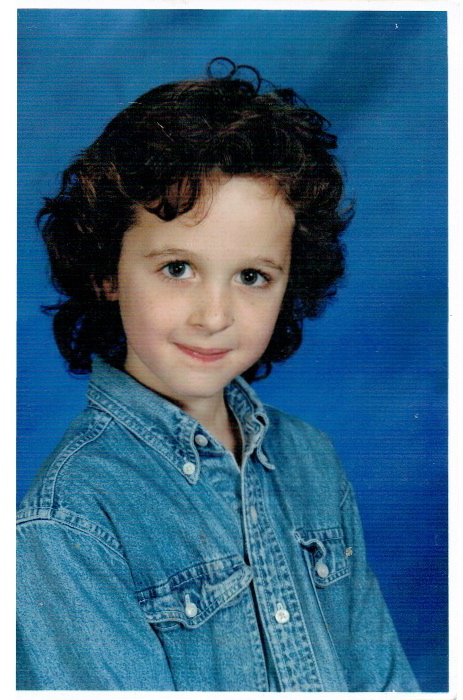
I don’t know how I got on to that whole thing when what I wanted to write about is what I see when I look at that picture of Philip, and how there are times when I feel like his death is killing me softly and slowly. I try to write truthfully, to stay away from sentimentality, from victimhood. But when I look at this picture – and for some reason I’ve been thinking about it and staring at it for days now – I see an angel and I remember what a sensitive kid Philip was. I remember the way he used to toddle after me, even into the bathroom, how he’d cry if I closed the door. And I loved it because I knew it wouldn’t last. I remember the poem he wrote in second grade, where he named all his friends, but ended by saying that I was his best. I remember the day when we first moved to Montclair – he was seven, like he was in the picture – and I looked out my window to see him in front of our house, leaning on a telephone pole, watching my neighbor’s kid across the street. Jimmy was a year older than Philip. He was on his front lawn playing with what looked his entire little league team. Back and forth I looked with a tight stomach and sagging heart, knowing Philip wanted to be invited over, knowing that if they were letting him stand there, he wasn’t going to be.

But Philip got himself into that, and he’d have to get himself out of it. What parent doesn’t wish they could protect their kid from any-and-every-thing? But we can’t – and if we think about it, why would we want to? Because sooner or later they’re going to be on their own, and what then, if they’ve never figured out anything by themselves? And how does one live more deeply and with meaning, without having had to move through suffering in some way or another? Because not only don’t we get out of here alive, we don’t get out without grief.

When I look at that picture I see Philip at nine, at a pool party with his friends and their families. I see him coming over to me and Phil crying, because his friend Tim pushed him. He didn’t understand why Tim was mean – that’s what got to him. One by one the kids in the pool began looking our way and whispering. It’s that pack mentality that senses weakness – it’s the scent of blood, and they were circling for the kill. Philip’s weakness was wanting to belong but not feeling he did. Plus he broke the unspoken rule of not “telling” on another, a sin with a hard recovery.

Phil went to speak to Tim’s dad, who told him Philip should have pushed back. I think nine is a good time to tell your kid not to lay your hands on another kid if it’s not self-defense. But what do I know of a boy’s world? What I knew was my son was crying and everyone was watching. And what greater humiliation than to be the shut-out of the group, to be the kid leaning on the telephone pole, watching.

When we got home, I knelt down to talk to him. “Philip, look,” I said, “I don’t care if you cry. But those kids aren’t going to be nice to you if you do. Maybe you could try really, really hard next time not to cry, and just tell yourself you’re going to wait until you get home. Because here you can do what you want. Go in your room if you have to. Cry, yell, whatever. But don’t give them any reason to make fun of you.”

I was begging him, really, to let it go, because then could feel better. You know how it is – your child doesn’t hurt without you hurting right along. But it didn’t work. Philip was upset and didn’t say a word. So I stopped talking and stepped back because this was something else he was going to have to puzzle out on his own. And I had to trust that he would, and that both of us were going to be all right.

And that’s not all I see, but it’s all I’ll talk about for now.

© 2014 Denise Smyth

1/20/91 ~ 2/23/12

It’s no exaggeration to say that I knew the worst moments of my life on February 23rd, 2012. One of the first things I thought when Phil told me Philip had died was, “Right now, this very second, there are people all over the world who are feeling like I am right now. And if it is possible to feel like this, what is the point of being alive?”

Many of you know exactly what I’m talking about. And all of you are helping me, every day, to find some “point.” You have shown me love and so taught me gratitude. Because without love, without connection, there is no point.

I thought that instead of writing something today, I’d scan a bunch of pictures of Philip and post them, but that didn’t feel right. For  reasons I can’t yet figure out, posting that last picture of Philip and Natalie sent me spinning into despair. Then I thought I’d post some quotes from an anthology  I have of writers and poets on losing a child. Except I read so much of that book today that I started to drown in it all, which meant I wasn’t breathing and the world was turning into the color of death.

I haven’t much to say. It’s quiet time now. But I wanted to mark this day somehow, so here it is. And I’ll end with just one quote, which pretty much sums it up:

“I love the boy with the utmost love of which my soul is capable, and he is taken from me…yet, in the agony of my spirit in surrendering such a treasure, I feel a thousand times richer than if I had never possessed it.” ~ William Wordsworth

RIP Philip – my love, my heart, my son.

© 2014 Denise Smyth

Previous Older Entries Next Newer Entries