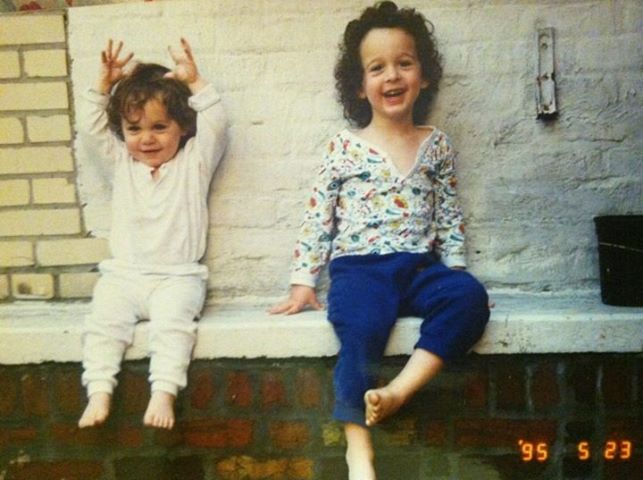
Natalie, almost 2, and Philip, 4
This is what our children give us. And no matter what, it’s with us always. Enjoy them; I know I did.
A broken heart is open to receive…
02 Feb 2014 10 Comments
in Death, Motherhood Tags: bereavement, death, death of a child, faith, grief, grieving, loss, loss of a child, motherhood
Natalie, almost 2, and Philip, 4
This is what our children give us. And no matter what, it’s with us always. Enjoy them; I know I did.
01 Feb 2014 40 Comments
in Death, Motherhood Tags: bereavement, death, death of a child, grief, grieving, loss, loss of a child, love, motherhood

Me and Philip, August 2012
Two years ago today was the last time I saw Philip; February 1st, as in 2/1 or 2/01 which will make sense if you read what I wrote here.
We went to dinner at the moderately expensive restaurant called Next Door, so named because it’s next to Blu, its older, more expensive sibling. It’s the omission of the “e” that makes you think it’s okay to pay up.
We ate, we talked. When we were done Philip asked if he could leave before the check; he had to get to fencing practice. Of course you can, I said. We stood to say good-bye and the restaurant became the stage where I kissed my handsome, 6’1” son for what would be the last time. Are you all watching, I thought; are you looking at this child of mine, this beautiful boy I mothered – me, I did it – and do you see what I see?
Turned out someone was watching. I sat to wait for the check and the woman next to me smiled. “You always worry about them, don’t you?” she said. I smiled and nodded but truth was I didn’t worry. Philip and I were solid and if what was between us was right, what did anything else matter?
Then the unimaginable – that’s what came to matter.
© 2014 Denise Smyth
31 Jan 2014 17 Comments
in Addiction, Death Tags: #WPLongform, AA, addiction, Alcoholics Anonymous, anorexia, bulimia, death, death of a child, grief, grieving, loss of a child, suffering
I ended my last post with what was to be next. Instead, I digress.
*******************
AA says you’re only as sick as your secrets. The light’s supposed to shine away the dark. Because it’s always there, the light. It’s a matter of if you see it.
Secrets are built into addiction. It’s a matter of survival. “Addiction” becomes this thing you are, not this thing you have. It’s a force, and it wants to survive. It’s not supposed to be able to thrive in the light. So where does the light come from? Just from telling the secret? What exactly happens when you say the thing you think you are or think you have? With all the AA I’ve absorbed, you’d think I’d know.
I have bulimia and anorexia. I don’t mean I had bulimia and anorexia. I mean I have bulimia and anorexia. That’s been my response to Philip dying. At first I wouldn’t eat. For months after Philip died I picked at food. I was drained. A bag of bones my clothes hung on. It wasn’t so much a choice; the food wouldn’t go down. Anxiety was a tsunami in my belly. If anything went in, it would have been blown back out.
In the mess of days after Philip died, people wanted to feed me. “Are you hungry? Can I get you something to eat?” they’d ask. I could only shake my head. I couldn’t eat, I couldn’t talk. I couldn’t do normal. I couldn’t pay attention to anyone because they weren’t in my world. In my world the only answer was, “I will never eat again; I will starve myself to where my son is.”
David Foster Wallace, himself a sober addict when he died, wrote about benign and malignant addictions. “Many addictions, from exercise to letter-writing, are pretty benign.” He then adds, “… something is malignantly addictive if (1) it causes real problems for the addict, and (2) it offers itself as relief from the very problems it causes.” And so round and round I go.
I am so damn angry. And I’ve a habit of punishing myself when I suffer loss, which I wrote about here. In the past, it was about The Guy. The one who always turned out to be a jerk, because, of course, it was his fault. All I wanted was to be loved. I lived for these guys, yearned for them, dressed for them, got on my knees for them; why the fuck couldn’t they love my need away? So I’d leave them, depressed and angry, and start the Food Games. Months of barely eating until my body couldn’t take it any more, at which point I went to war with it. Hunger was a betrayal, forcing me to eat when all I wanted to do was die. I’d sneak into delis and grocery stores, head down, walking as close to the shelves as I could, as embarrassed by my hunger as by my cartful of cookies and cupcakes and chips. I’d start eating in the car, and once I was home, tore through that food until I felt like a blimp about to burst. Then into the bathroom to hurl it all back at the universe. And soon as I got hungry again, I did it all over. Buying more food at different stores. At my worst, binging eight or nine times a day. At my worst, all 5’4” of me weighting 98 lbs., and counting down.
It was my mind that drove me crazy, and my body that I punished.
So what happened? At 28, I met my husband and it hit me it was either him, or my crazy. I chose him. I got help. I settled down. I learned how to eat, how to listen to my body. I stabilized at 125 lbs. The more I let myself eat, the less food was an “issue.” I got married, had kids. And to my wonder and surprise, after Philip was born, I lost more than my pregnancy pounds. I weighed in at 118, where I stayed for the next 20 years.
The blow of Philip’s death blasted me into a suffering I was helpless to deal with, so I turned to food. Same pattern – I went from barely eating, to vomiting. Back and forth, back and forth. Down to 102 lbs., obsessed with staying there. Telling no one; not anyone, for longer than I can remember. Until the day I told Kirsten, told Rose, who is sweet and lovely and who I’ve yet – but hope – to meet. Finally, I told my therapist. And most importantly, I told Natalie, because I would never have taken the risk that she’d find this out through a blog instead of directly from me.
I’ve been throwing out weight and height to make a point, to make the picture clear. To make myself see what I am doing, to shake myself into some semblance of caring for myself. Because much as I’m taking the steps to do what’s right, it’s coming from “I have to,” not, “I want to.” The have-to is because of Natalie; I love her enough to understand she needs me right where I am. It’s all for her; I don’t know how I ever let it get to be for me, too.
Here’s where I stand: I have stopped throwing up. I am afraid to eat, even though I do. I do not weigh myself. I am probably somewhere between 110 − 115 lbs. I am told I am too thin. I do not believe that. When I look in the mirror I don’t see what you do.
And I’m exhausted; I’m tired of worrying about food, tired of it always being on my mind, tired of the voices in my head that don’t even sound like voices, just sound like normal thoughts. Normal? Here’s a sample: “Oh, are you going to eat that for lunch? That’s too heavy. You better not eat breakfast. Eat some grapes and drink some Vitamin Water. Don’t finish what you’re eating. It’s good to leave food on your plate. What are you going to eat for dinner? You ate lunch, after all, you can’t eat too much for dinner. And don’t eat too late. What? You’re eating popcorn at 10:00 at night? I don’t care if it’s fat-free; that’s bad. Very bad. Bad, bad, bad.”
This isn’t the end; it’s just all I can say for now.
© 2014 Denise Smyth
26 Jan 2014 19 Comments
in Addiction, Death, Lonlieness, Motherhood Tags: #WPLongform, addiction, bereavement, death, death of a child, grief, grieving, heroin, loss, loss of a child, overdose, suicide
“I keep one foot out the door, and that’s suicide by increments.”
Rob (played by John Cusack) in “High Fidelity”
And that, right there, is the problem. I’ve a lead foot out the door and I think it’s soldered there. There’s an uncertain fear I live with and don’t care to define. Ed’s done it for me: “You are afraid to live because you think you’ll lose Philip.” But what does it mean to live, I want to ask him; show me how. He’d only shake his head because really, what else could he do? He can’t show me how to live because life isn’t given you by someone else, and if you think it is, it isn’t yours and you’ll wind up resentful, angry and either half-alive or half-dead, depending on the way you look at such things.
I keep thinking that living means having oh-so-many friends and taking fabulous vacations and talking on my cell when when I’m not texting on my cell and Facebooking, Twittering, Instagramming and “connecting” whatever latest way the internet’s figured out how to keep us glued to each other 24/7 because God forbid we should spend too much time considering. Life. Death. Meaning. WTF. It’s exhausting. But that’s not what Ed means by living. He means taking my foot out that door, which has to do with being, not doing. That still gives me only a vague idea of what it means to be in life. And what I see when I come close to sensing what living means is that I’m afraid if I’m not shaming myself, then someone else will do it for me. Somehow, that foot out the door feels like protection.
Hecht writes, “When a person dies, he does wrenching damage to the community.” And, as Hamlet says of suicide, “ay, there’s the rub.” He’s talking of his uncertainty that death is any kind of end; I’m talking of what happens to those left in the wreckage of a loved one’s suicide, as well as the collective impact. Living carries responsibility with it, which includes taking seriously my effect on other people. I have to tell myself this because I don’t know it. I know I love Philip and I know I love Natalie; what I don’t know is how much I matter to both of them. Nor do I seem to “get” what I mean to other people.
And I think people who kill themselves don’t get what they mean to others. I’ve heard suicide called “selfish.” That’s a cruel, shallow, ignorant and cliched way to describe someone who’s in such devastating pain that it overwhelms consideration of anyone else. For many, it’s almost like there is no one else because it feels like no one can help and no one really cares, not really. Because it doesn’t penetrate. Because when you look around it seems like everyone else’s figured out this thing called life while I’m some solitary freak who can’t even find any other solitary freaks to commiserate with. I mean, what is it that keeps people wanting to live? It’s got to be love, doesn’t it? For people, for art, for work that is satisfying; for nature and its mysteries. That feeling of aliveness where you’re engaged in what you’re doing or who you’re with and there you are, being. But what if you can’t feel anything but the lack of it all, the “Why?” that has no answer?
I can’t speak for anyone else, but my experience can’t be unique. I’ve wanted to die because I couldn’t feel love from anyone out there. I mean, I could feel love toward certain people – most deeply and particularly my children – but it didn’t feel reciprocal. When they were little, in my worst moments I would tell myself that I would kill myself when Natalie turned 16, because by then she wouldn’t need me any more. She’d be well on her way (where the hell did I think she was going?), I’d be one more thing out of her way. Dead mom? Blip in the road, a stumble with quick recovery, then back to it like I wasn’t really there in the first place.
I believed this.
“We are all members of society,” Hecht writes, “and these connections are to be honored.” She says suicide creates more suicide. So I think about this. I think about the way Philip died – it was an accident. And I think of what I went through when I first learned of it, what I’m going through now. I was tortured; it didn’t matter that there wasn’t anything I could’ve done. I’m his mother – I was supposed to protect him. I was sick at the thought that there was a moment when he knew he was going to die, and he was alone and terrified but he had to let go. No way, I’m told; because of the heroin he went out in a blaze of bliss. I’m not so sure, but there isn’t anything I can do about it.
But as devastating as Philip’s death is, what if he’d chosen to killed himself? The things I hold on to are that he was a happy kid, that we were close, that there wasn’t anything unsaid between us. That I’ve nothing to feel guilty about unless I choose to make it so. But look at what his dying has done to me, to his father, to his sister – to all who knew him. The shocking, mindless blow of it. Do I think my own death would be any less shattering? What worse thing for Natalie than to live with a mother who’s not only dead, but dead by her own hand? So she not only gets to suffer my death, she gets to spend her life wondering why she wasn’t enough for me to live for.
And if I would do such a thing, in what meaningful way would I have loved her?
A few months ago, in my bathroom, I got a pain in my chest. It wasn’t about my heart – more like indigestion. But it caused me to bend over, and I closed my eyes, and made believe it was my heart. I might be dying, I thought. My heart might be shutting down and I might just keel over and Natalie’s upstairs, my God Natalie’s upstairs, I can’t leave her now, she’ll freak. She needs me to stay with her – I don’t want to leave her. So there was a crack in the atmosphere and I got it…but where’d it go? Do people live in full knowledge that they matter, they very much matter, to those who love them?
And so I have reason to Stay. But I’m missing the part about wanting to. I’m more attached to Philip’s death than Natalie’s life.
Next: What Philip says about that.
© 2014 Denise Smyth
20 Jan 2014 42 Comments
in Death, Motherhood, Uncategorized Tags: bereavement, death, death of a child, grief, grieving, loss, loss of a child, motherhood

Philip at 6
I always sent Philip a text right after midnight to say Happy Birthday, so here I am. I don’t remember how it was last year, that first birthday. It was a Sunday, and Natalie took me horseback riding. It was a surprise; she knows I love to ride, and I hadn’t, not since the last vacation the four of us took together.
It wasn’t so much his birthday; it was the days following. I’ve found that’s when grief starts kicking my ass, in the aftermath. This year I’ve been walking in a white cloud of Philip. Walking along with pregnant-me, my belly full of him. Sitting with me on my bed, nursing him in wonder and stroking his soft, downy head. And seeing my 21-year-old son watching me, ever reminding me those moments are mine and not even his death can take that away from me.
I found this picture of Philip right after he died and I couldn’t bear it. You know why it’s so hard for you to look at this picture, he asked? Because you see the joy in me and you think you’ll never find it in you. I came from you, mom; if I have it, so do you. I do? Could I ever radiate, knowing what I know of death and loss and grief? I feel old in ways that are exhausting; I feel dirty next to his bright innocence. And guilty, that I now know what neither of us could, that he was only years away from the train wreck his life would end in.
I took today off because I think I would go crazy if I had to sit at work and pretend this is a day like any other. Birthday number two and I’ve not figured out how to mark it. What special thing there is to do. It seems it would be comforting to have a ritual, but I can’t think what that would be. Maybe I’m not to live a life of tradition; maybe I’m to learn to take it as it comes. Kirsten is making dinner for Natalie and me. Will you do this every year, I want to ask her? Can I count on you to always be here?
Let us enjoy our dinner tonight, let that be enough for now. Let me learn one by one that people love me, let me hold what I learn in my heart.
And let me, as Philip has asked, learn to find the joy.
© 2014 Denise Smyth
13 Jan 2014 17 Comments
in Death, Faith, Motherhood Tags: #WPLongform, bereavement, death, death of a child, grief, grieving, loss, loss of a child, motherhood, suffering, suicide
Naturally the first (and as yet only) chapter of Jennifer Michael Hecht’s “Stay” that I’ve read is “Suffering and Happiness.” Because as anyone who’s tried to delve into what they suffer knows, lots of people have lots of things to say about the suffering/joy thing. I will not ask the one question that haunts: why? I mean, why the fuck does one have to suffer to know joy? Hell, I can even answer that in my own way – but it doesn’t satisfy, not really. But suffering transmuted can liberate me from believing that I must suffer. Can show me, if I’m honest, what my part is in what I feel. Like everyone, I suffer within the context of my life, and Philip is now the focal point of that suffering. But as I’ve said, he’s told me not to make his death into something it isn’t. I have to get my head out my ass first.
And what I mean by “suffering in the context of my life” is that Philip’s death is of a part of the rest of it. A really simple way to understand that is if you’ve generally been okay with being alive you’ll probably wrestle with your child’s death differently than if you’ve spent most of your life thinking you and those around you would be better off with no-you. I mean, one of the reasons I used to think it’d better if I died was because my insurance policy would pay for my kids’ college.
Think I had some of those self-esteem issues we hear talk about?
My cousin Maria remembers that when I was a kid I always loved gray days. They make me feel safe, I told her. Nothing’s changed. I’m looking out my window now, where the sun’s breaking through the clouds that just yesterday were full of rain. I’ve a pit in my stomach; they always leave, the clouds. Always. There’s more sun-time than cloud-time and it doesn’t seem fair. What I feel good about is temporary, leaves too quickly. What keeps me twisted is reliable. And that’s pretty much how life’s felt.
I don’t much like Hecht’s poem, “No Hemlock Rock (don’t kill yourself); there’s a certain silliness to some of it and I’m not sure what she’s trying to do:
Don’t kill yourself. Don’t kill yourself.
Don’t. Eat a donut, be a blown nut.
That is, if you’re going to kill yourself,
stand on a street corner rhyming
seizure with Indonesia, and wreck it with
racket. Allow medical terms.
Rave and fail. Be an absurd living ghost,
if necessary, but don’t kill yourself.
I guess she’s saying be crazy, do anything, anything at all except kill yourself; but those words have nothing to do with me because I’m hurting and and it’s too much effort to go out and get a donut and I don’t even know what it means to be a blown nut.
But “Stay” is something else. When two of Hecht’s close friends killed themselves, she wrote an open essay letter on a blog that she writes for. “Life has always been too hard to bear, for a lot of people, a lot of the time,” she wrote. “It’s awful. But it isn’t too hard to bear, it’s only almost too hard to bear.” She tells us to sob and be useless because “Sobbing and useless is million times better than dead. A billion times.” She calls those who want to kill themselves but don’t, heroes.
I’m no hero. I didn’t kill myself out of fear; nothing heroic about it. And before I start going on about how cowardly I am that I didn’t, I’m going to switch gears. I have to start seeing things differently. I’m not into heroics, so I’ll just say I have some level of sanity or I’d’ve thrown myself drunk in front of one of our Montclair rail crossings.
But how crazy am I to be touch with Philip daily and yet want to die because he did? What is it about the dark that attracts me? Philip told me that he is my teacher where he is, and Natalie’s my teacher where she is. He’s here to show me what death isn’t; she is showing me what life is. But it’s Philip I listen for and yearn for and learn from; I don’t learn from Natalie. She’s intense and blooming and instead of learning that from her, I sit on the sidelines because I can’t have that. Too late, don’t know how.
How complicated is this all? Philip was my first born, and extraordinary to me. The first thing I’d done right; and when I saw the beautiful child he grew into, all the more proof of what I was worth. He was my light. Funny thing is, there were times I thought I was paying way more attention to Natalie than to Philip; but my children needed what they needed, and Natalie needed more. Philip was my steady. Lights don’t go out, I said when he died; they just don’t. “I didn’t go out, mom,” he says. “Have a little faith.”
See, I can bow my head every day in gratitude when he lets me know he’s near. But what good is it if I don’t learn to live. If I want to work with what he’s trying to teach me, then I have to be willing to follow Natalie’s lead.
Hecht quotes Ann Sexton: “I don’t want to live…Now listen, life is lovely, but I Can’t Live It. I can’t even explain…if you knew how it Felt. To be alive, yes, alive, but not be able to live it…I am like a stone that lives…locked outside of all that’s real…I wish, or think I wish, that I were dying of something for then I could be brave…to [be] behind a wall watching everyone fit in where I can’t…to live but to not reach or to reach wrong…to do it all wrong…I’m not a part. I’m not a member. I’m frozen.”
I know this. I know every word of this. I’ve said it all, down to wishing I was dying so I could be brave. So I am not alone. But this is what else I know: It does not have to be this way. I don’t have to be this way. I haven’t figured out what that means yet. But this is only part two.
Next: Suicide, Part Three
© 2014 Denise Smyth
05 Jan 2014 35 Comments
in Addiction, Death, Lonlieness Tags: #WPLongform, addiction, alcoholism, bulimia, death, death of a child, depression, grief, grieving, loss, suffering, suicide
No, I’m not going to kill myself. But I’ve been preoccupied with being dead, and since the inner eventually becomes the outer, all things suicide have been coming my way.
Natalie bought me a book about suicide for Christmas. “Stay,” by Jennifer Michael Hecht. I find the title wrenching. “Dad asked me if I bought it because I was worried you’re thinking about killing yourself,” she said. “I told him no, it’s just I know you’re interested in suicide.”
My therapist is concerned. So I asked Natalie, who, after getting annoyed about the whole thing, pointed out that she knows I once tried to kill myself and hence, my interest; that she heard about the book on NPR, which gave her the idea to buy it; that if I was going to kill myself I would have already done so, since I’ve gone through the worst thing in my life so far; and that anyway, I wouldn’t do that to her. And no, I wouldn’t.
But she’s the thread I’m hanging from. I have enough sanity to see she’s a reason not to die. But it feels impossible I’ll ever get to the part about wanting to live. Or maybe I don’t think about that for the next few-whatever. Maybe I first get through Philip’s birthday on January 20th, then February 23rd when it’ll be two years since he died. Because if I’ve learned nothing else these last two months, it’s that this year-two stuff is pretty sickening. Year one’s unreality has been replaced by year two’s finality, and where’s there to go from here?
I get a daily poem from The Writer’s Almanac, which, by the way, is connected to NPR. 95% of the time I don’t read them. But one day last week, I got two emails from the Almanac, the second one correcting the first. Maybe I should read it, I thought; maybe that poem’s trying to get my attention. It was a poem about suicide. I mentioned it to Natalie because of the book she’d given me, and she said maybe it was the same author. So I checked, and sure enough, it was.
And if that’s not enough suicide-stuff, a couple weeks ago, I got a link to a blog post about suicide. The blogger – who I think had once felt suicidal and is now really happy to be alive – decided that those who kill themselves are selfish and cowardly. I don’t argue online – I don’t usually have the energy or self-righteousness for it. But this closed-minded, cliched version of What Kind of People kill themselves incensed me enough to let the blogger know exactly what I thought, which included the fact that many who’d read the post were the ones who’d lived through a loved one’s suicide, and what kind of burden does that add to a load that’s already broken a whole bunch of people to pieces? (And the end of that story was instead of getting flipped-off, the blogger read my entire blog and left a lovely comment. Who knew??)
Since Philip died, I’ve come across people whose loved ones have killed themselves, and I don’t pretend to know what kind of hell it is to live with that. Especially if it’s your child – what ginormous excess of grief must that create? Suicide has nothing to do with the people who love you. It has to do with unfathomable loneliness, other-ness, not belonging, not seeing, not getting why you’re alive if this is what it feels; if all/most of the time, this is what it feels like. And screw feelings-aren’t-facts. Feelings are the world if that’s what you let them be.
My secret mantra has yet again become, “This won’t last forever because I will die.” Not exactly suicide, but a way of becoming one of the walking dead. I already wrote about what Philip said to me about suicide here. And I promised him I’d stop wishing myself dead. But lately, I’m not hearing anything but the battering between my ears, and I don’t know what it is I’m trying to accomplish with my little mantra. Maybe I think it’ll bring a natural death faster, and no one will blame me if that’s how I go.
I become unreachable when I’m lusting for death, which I’ve long considered the only way “out.” When I finally figured out that if I thought death was the answer, I was asking the wrong question, Philip died. And even though I remind myself that death remains the wrong answer, these last few weeks I’ve given up and given in and I see no way through. I’m not in touch with anything inside me that knows how to live, much less wants to. It seems wrong and unnatural, but life’s never much felt like a home I belonged in.
For whatever the reason, I was miserable and angry about life since I was a kid. When I turned 11, I decided the way out was to drink. By 14, I added pot to the mix. By 22, I had bulimia. For years I turned the rage I felt but never understood into a scathing diatribe against myself. I swore God took special pleasure in my unhappiness or else He’d make it go away.
When I was 21, I sat in my parents’ bathtub at 4:00 in the morning while they were away for the weekend, drinking and hacking away at my wrists with a razor blade. I thought I was making progress when the blood started spraying, but that’s when I heard the phone ringing. I guess I wanted to live more than I wanted to die because I answered it. It was my soon-to-be-ex-boyfriend, Chris. Earlier that night, I’d left him at a party, drunk and angry that he hadn’t given me any of the Quaaludes he’d already passed out from taking. What he later told me was that he’d woken up out of his stupor and knew something was wrong when he couldn’t find me. He came over and wanted to take me to the emergency room. I refused, so he wrapped a towel around my wrist and went to a 24-hour drugstore for some butterfly bandages. When he was done patching me up, I sat in the bathroom watching him clean the blood from the walls around the tub. On his knees, he tossed his long Jesus-hair back over his shoulders and never said a word while he worked. I longed to lay my head on his long, narrow back while he rinsed that bloody rag. I wanted him to love me as much as he wanted to save me, but when he stood and turned to me he was the Chris I knew again, his ever-increasing remoteness further justified.
After that, I went to therapy. I still didn’t want to live, but I was embarrassed by my failed attempt and by what I considered my cowardliness because I knew I wouldn’t do it again. By 24 I went to AA and I stopped drinking. By 30, I married Phil, which went a long way toward stabilizing my violent moodiness. I relied on his steadiness, but it offered no insight into how to build a life that I could enjoy. I’d stopped drinking and vomiting and had even given God a shot, but I wasn’t happy. I was living in a long, gray corridor called depression. Wanting to die was my default position, the only way to permanently right what was wrong. I got it together for everyone else; I loved my kids and took care of my family, but the life I was living didn’t seem to include me. I was bored staying home with the kids, unhappy being married, despondent because I had no career, resentful that being a wife meant having sex when the only touch I didn’t object to was that of my children. I was waiting my life out. I thought about swallowing pills but had no idea how to get them. Sleep was the only peace I knew, and the nights I was particularly despondent I’d crawl under the covers, pull them up to my chin and curl up to say my adult version of the prayer my mother taught me as a kid:
Now I lay me down to sleep
I pray the Lord my soul to keep
I pray to die before I wake
I pray the Lord my soul to take.
But the Lord wasn’t listening, so I kept a package of razorblades in my kitchen drawer. I might’ve been too scared to use them, but they were my version of hope.
Next: Suicide, Part Two
© 2014 Denise Smyth
28 Dec 2013 51 Comments
in Addiction, Death, Lonlieness, Motherhood Tags: #WPLongform, addiction, bereavement, bulimia, death, death of a child, grief, grieving, loss, loss of a child, suffering
Fuck art. It’s time for a rant, because really, I’m exhausted. Not for lack of sleep. For my mind tripping over my broken heart to figure this out or make meaning or whatever the hell it is my mind is trying to do while it’s continually screaming Philip is dead Philip is dead Philip is dead dead dead.
WTF? What’s today? I don’t know but it’s the Aftermath. The Christmas quiet which I used to wind down with my family, wrappings gone, bows saved, boxes still under the tree like we could open our presents all over again. My family, of which 1/4 is dead, 1/4 I’m separated from, and 1/4 is beginning to leave on her life’s adventure. And I am paralyzed because there’s nothing in me to be adventurous, there’s nothing in me that wants to go out and do anything. WTF kind of life is this? I can’t carry Philip’s death. It’s too goddamn heavy and I don’t know what to do. I miss him, I goddamn miss him. What does anyone do? What do you say to yourself, what do you do with your time when you’re suffering? I wrote a post called “What I do” about that, but there’s more. There’s food, there’s not eating, or eating and vomiting, and torturing myself that I’m going to get fat and fretting about it all the time and for shit’s sake I’m 55 and I’ve got adolescent eating problems. I am exhausted.
Somebody told me that Joseph Campbell said – big paraphrase coming here – that it’s not meaning that people are searching for, it’s the feeling of being alive. WTF? So I’m doing it wrong again? I thought I was trying to make some damn meaning out of all of this and be on my merry way to some peace, which is another idea I have the way I had an idea about forgiveness. Because I keep thinking I want peace which, in my idea, feels not like life but like tolerance of life, which is feeling very fucking empty right about now. Is that what I really want? A life that’s “tolerable?” Any wonder why I’m waiting to die? Why do people want to live, I asked my therapist? What’s with the wanting?
Why do you want Philip to live, she shot back? Which brings up a whole shitstorm of questions like, WTF is life, really; what is it when I can hear my son and read his signs and feel his nudges which would mean (there’s that word again) that life can’t possibly be about a body so it must more be about connection.
There it is. I don’t feel connected to anyone right now, not myself, not Philip, whose eyes I feel watching me even as I write this. And I don’t mean “eyes” as in those of a body but I am restricted to language to talk about what’s going on and “eyes” watching me conjures up what I’m feeling. I feel his watching, his patience. I feel him waiting for me to calm the fuck down and begin again. So, what then? Am I connected, or am I not?
Maybe when it comes to Philip, I’m never completely disconnected. There’s some thread that at the moment is stretched to breaking even though I know it won’t. But it’s not enough. There are people here, people with flesh and hair and body fluids that leak from all different places; people that take up the same space as me and to need to be paid attention to. There’s Natalie, for starters, who I sometimes feel like I’m watching through the long end of a telescope. She’s there; she must be. But I can’t take in that I matter to her or anyone else and it’s that profound loneliness that’s dogged me since before Philip was born and is unfathomably murky now. But there is no one to hug me. There is not one person I can sink into.What’s it matter? echoes the hollowed out place my heart’s supposed to be, and where not coincidentally Philip asked me to place that diamond. Light it up, mom; see what’s really there. But I think it’s a big, fat nothing. I think it’s loss upon loss with more loss to come because what else is life anyway? Being ready for the loss. As if you could be, even when you know it’s coming. (Tersia, Lucia – are you reading this?) In “No Chance,” Lou Reed sings of not having a chance to say good-bye to his friend who died: “There are things we wish we knew and in fact we never do / But I wish I’d known that you were gonna die.”
Really? ‘Cause I don’t. I dreamt of Philip maybe three times since he died. In one dream he was telling me he needed some fencing gear, and that he needed socks. “If you did your laundry, you’d have socks,” I’d thought, much to my surprise because I knew that on Sunday, he was going to die. I was sorry to have thought that about the socks, and it was awful to tell him yes, we’d go get his fencing stuff even though I knew he’d be dead before he could use it, and there was nothing I could do about it. Just keep acting normal until it happened. So no, I don’t wish I knew he was going to die. Something had been driving me those last months, something that made me choke on my love for him and make my twisted way into his heart to let him know how much I did.
So WTF? What’m I supposed to do? Nothing’s working here. I don’t want to knit or sew or read or cook or watch TV. I don’t even want to drink, which sometimes I think I do, but which I know won’t help ‘cause I’ll wake up worse. A pill, maybe. A big, fat pill – or several small ones – so I can go to sleep, which is my version of peace. It won’t make me connected to myself, but it’ll sure make me forget that I’m not.
© 2013 Denise Smyth
26 Dec 2013 9 Comments
in Addiction, Death, Faith Tags: #WPLongform, addiction, bereavement, death, death of a child, forgiveness, grief, grieving, loss, loss of a child, overdose, spirituality
I was asked to guest post by Becki Duckworth at http://isurvivedamurderattackmyfamilydidnt.com/ Becki’s story is brutal; you can read about it here.
And you can find my next post here.
I wish all of you peace on this day after Christmas. I find it’s not the “day” that’s hard as much as the aftermath, when I’ve survived to find yet again that life goes on and I’m just not sure how I’m supposed to go along with it.
14 Dec 2013 38 Comments
in Death, Motherhood Tags: bereavement, death, death of a child, grief, grieving, loss, loss of a child, motherhood
That caustic dread inside your head
Will never help you out
Lou Reed, “Magic and Loss”
The other night Natalie said, “You hate the holidays.” “Why do you always say that?” I asked her. “I don’t hate the holidays. I like them a lot. I like the feeling of them. I mean, I’m uncomfortable about Philip. But I like to get people presents. Really. I’m at the point where I like to give presents more than I like to get them.”
Where do I start?
“Uncomfortable” about Philip?? That’s what I’m reduced to saying when I talk to Natalie about anything concerning Philip. She can’t take my grief, even though for a long time now I’ve not made it particularly visible to her. I give her a lot of attention, and I make sure she knows I love her. But any mention of Philip is a centripetal force, drawing her ever more inward and away from me. And it’s especially hard that I can’t speak easily about Philip to her during this Season of Celebration. This second Christmas without him, I’m feeling defeated because nothing’s going to make him come home and what the fuck am I supposed to “do” with what I’m feeling?
Every year Natalie tells me I hate the holidays. And I do remember one year complaining about all the time, work and energy the holidays required because I was the one doing it all. That must’ve left a real impression on her because she’s turned it into my “thing” when it’s not at all any kind of “thing.”
But it’s forced me to think about the holidays, what they are, what they’ve been. When I look at Christmas Past, I think something was left out, some part of me wasn’t there. What I did best was buy the right presents, because to me, they were expressions of love. It was the act of giving that moved me. I wrapped them up, then typed their names on the gift tags because when I was in second grade, I realized there was no Santa when I recognized my dad’s handwriting on the tags. And I was terribly impressed with myself for figuring that out.
To slow down the process of tearing into the presents it took hours to wrap, I’d put little poems on each tag that described the gift. Philip and Natalie took turns reading each one, and had to guess what their gift was before they opened it. And I remember one year I got my husband a bike and hid it in the basement. On Christmas morning, there was an envelope under the tree for him that had directions for what he had to do next. The kids and I had written down clues on pieces of paper, then we hid them all over the house, each clue directing him to the next until he was finally directed to the basement where it didn’t take him long to find the bike under the tarp that was hiding it.
Sounds good, right? But even though I remember those things, I also remember something felt wrong. I loved a tree-lit, garland-filled home, but not what it took to get there. The tension of decorating, the way kids would help but they really didn’t want to. It was supposed to be Christmas Carols, hot cocoa and stringing popcorn. Or something all red and gold and warm. But this is how it really was: Every year, a couple weeks before Christmas, my parents would come to help decorate. Wind up was I’d be the one helping while my mom was directing. She was fast and irritable and if she wasn’t decorating she was cleaning and that can sound like gee, wish my mom was like that, I’d invite her over more often, but it wasn’t that way. My mom would take over and I’d let her, then resort to sullen, resentful 12-year-old behavior to deal with it.
But what did I know? Sullen-and-resentful was the norm around my mom, who was a walking whirlwind of anger. She couldn’t help herself – and who’s to say that if I was born and raised the way she was, if I had her exact life, I wouldn’t be the same way? I was the one that had to wake up, who had to stop behaving like my mom could send me to my room and take away my toys while she was at it. But I didn’t get it. For all the 30+ years of therapy and binders filled with email conversations with Ed about this, I didn’t get it. So as much as I hated the tension and rushing of the day, I didn’t know how to make it the way I wanted it to be. I was sure I was doing it wrong and ashamed and sorry that my kids were stuck with me.
Sound a little caustic?
And now – now I do stress-free Christmas. My tree is up and my presents are wrapped. They’re not ribboned and bowed yet, but this snowstorm that’s just beginning will be the perfect time to do that. Next week I’ll make cookies, cakes and chocolate mousse, like I always do. And I’ll continue to alternate between crying and flatlining because my kid is dead and it looks like everyone’s celebrating.
Which I know isn’t true, mostly because of you all.
© 2013 Denise Smyth

 Forever 21