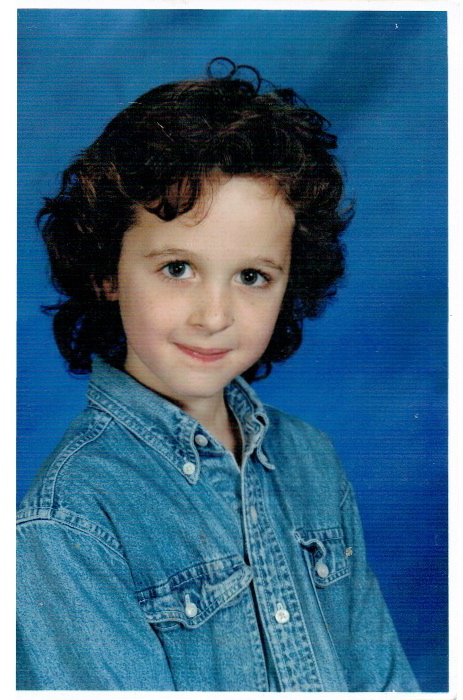
What I See

Philip at seven

Philip at seven

Last week I walked into therapy, sat down and made an announcement.

“I want to have a baby,” I said.

“What you need to have is a man,” she answered.

First off, in case you’re wondering, the baby ship sailed about five years ago. Second, that’s not exactly what my therapist said; she’s way more subtle and nuanced. But it’s what she meant, and it’s not about being saved – it’s about what I need and how I take care of myself.

It’s not just having a baby. I want to feel the fullness of pregnancy, I want to walk in the world belly-first. I want to use words like holy and sacred and cherish and tell you I’m on hallowed ground because that’s what it felt like to carry my babies. I want the peace and wonder of those all-too-short nine months. Twice in my life, I used to think; only two times in a whole lifetime do I get to be pregnant. And maybe I’m remembering all this in a blue haze of sentimentality, but I’m longing for Philip and it’s making me crazy.

The need I feel doesn’t seem to be for a man; but I suspect I’m needing to hold and be held, and it’s easier to feel it for a child than an adult. Hence maybe it is for a man. But I can’t see it, not the way I see my child’s gaze, my child’s sleepy arms around me when I carry him to bed. I can’t see it. I’m an adult. If I’m yearning to be held, then I have to think about how that happens. I’m never going to be pregnant, not in this life. If I have a need, I have to figure out a realistic way to meet it.

I don’t know how I got on to that whole thing when what I wanted to write about is what I see when I look at that picture of Philip, and how there are times when I feel like his death is killing me softly and slowly. I try to write truthfully, to stay away from sentimentality, from victimhood. But when I look at this picture – and for some reason I’ve been thinking about it and staring at it for days now – I see an angel and I remember what a sensitive kid Philip was. I remember the way he used to toddle after me, even into the bathroom, how he’d cry if I closed the door. And I loved it because I knew it wouldn’t last. I remember the poem he wrote in second grade, where he named all his friends, but ended by saying that I was his best. I remember the day when we first moved to Montclair – he was seven, like he was in the picture – and I looked out my window to see him in front of our house, leaning on a telephone pole, watching my neighbor’s kid across the street. Jimmy was a year older than Philip. He was on his front lawn playing with what looked his entire little league team. Back and forth I looked with a tight stomach and sagging heart, knowing Philip wanted to be invited over, knowing that if they were letting him stand there, he wasn’t going to be.

But Philip got himself into that, and he’d have to get himself out of it. What parent doesn’t wish they could protect their kid from any-and-every-thing? But we can’t – and if we think about it, why would we want to? Because sooner or later they’re going to be on their own, and what then, if they’ve never figured out anything by themselves? And how does one live more deeply and with meaning, without having had to move through suffering in some way or another? Because not only don’t we get out of here alive, we don’t get out without grief.

When I look at that picture I see Philip at nine, at a pool party with his friends and their families. I see him coming over to me and Phil crying, because his friend Tim pushed him. He didn’t understand why Tim was mean – that’s what got to him. One by one the kids in the pool began looking our way and whispering. It’s that pack mentality that senses weakness – it’s the scent of blood, and they were circling for the kill. Philip’s weakness was wanting to belong but not feeling he did. Plus he broke the unspoken rule of not “telling” on another, a sin with a hard recovery.

Phil went to speak to Tim’s dad, who told him Philip should have pushed back. I think nine is a good time to tell your kid not to lay your hands on another kid if it’s not self-defense. But what do I know of a boy’s world? What I knew was my son was crying and everyone was watching. And what greater humiliation than to be the shut-out of the group, to be the kid leaning on the telephone pole, watching.

When we got home, I knelt down to talk to him. “Philip, look,” I said, “I don’t care if you cry. But those kids aren’t going to be nice to you if you do. Maybe you could try really, really hard next time not to cry, and just tell yourself you’re going to wait until you get home. Because here you can do what you want. Go in your room if you have to. Cry, yell, whatever. But don’t give them any reason to make fun of you.”

I was begging him, really, to let it go, because then could feel better. You know how it is – your child doesn’t hurt without you hurting right along. But it didn’t work. Philip was upset and didn’t say a word. So I stopped talking and stepped back because this was something else he was going to have to puzzle out on his own. And I had to trust that he would, and that both of us were going to be all right.

And that’s not all I see, but it’s all I’ll talk about for now.

© 2014 Denise Smyth
1/20/91 ~ 2/23/12

It’s no exaggeration to say that I knew the worst moments of my life on February 23rd, 2012. One of the first things I thought when Phil told me Philip had died was, “Right now, this very second, there are people all over the world who are feeling like I am right now. And if it is possible to feel like this, what is the point of being alive?”

Many of you know exactly what I’m talking about. And all of you are helping me, every day, to find some “point.” You have shown me love and so taught me gratitude. Because without love, without connection, there is no point.

I thought that instead of writing something today, I’d scan a bunch of pictures of Philip and post them, but that didn’t feel right. For  reasons I can’t yet figure out, posting that last picture of Philip and Natalie sent me spinning into despair. Then I thought I’d post some quotes from an anthology  I have of writers and poets on losing a child. Except I read so much of that book today that I started to drown in it all, which meant I wasn’t breathing and the world was turning into the color of death.

I haven’t much to say. It’s quiet time now. But I wanted to mark this day somehow, so here it is. And I’ll end with just one quote, which pretty much sums it up:

“I love the boy with the utmost love of which my soul is capable, and he is taken from me…yet, in the agony of my spirit in surrendering such a treasure, I feel a thousand times richer than if I had never possessed it.” ~ William Wordsworth

RIP Philip – my love, my heart, my son.

© 2014 Denise Smyth

Yesterday, Today, Tomorrow

What fierceness to say, “I will never accept this.” What comfort is mixed up in that, knowing I’ve taken a stand. What despair is at the core of it, because not to accept what is, is a form of insanity. I can be as angry as I want, but that won’t change what is so. When I carry around anger about something I can do nothing about, it’s because I think anger is going to get me what I want. Why else remain angry? Why else tell myself the story of what happened so that I wind up the victim? What happens when I realize that I’ve taken some fact of my life, an event that happened in time, and told myself an unhappy story around it? Then I see how I keep alive the ghost of  the past and so miss my life, which is only ever happening now. Not in the past, not in the future. Now. But the voice in my head insists otherwise.

And if I think my anger isn’t an attempt to get something I want, I can think about the way I feel about letting it go. It’s  like if I’m not mad, then I’m saying something’s okay when it isn’t, and what an outrage that is. If I’m not mad, that person/institution/whatever gets away with “it.” How humiliating for me; if I’m not mad, I’ve lost.

Except that isn’t it, not at all. If I’ve let go that anger, it’s peace to me. It’s freedom. It’s not my job to see that someone doesn’t get away with something, as if anyone “gets away” with anything. An unconscious life is its own prison. Truth will out, with no help from me.

A year ago fall, the first fall after Philip died, I went outside one brilliant morning to walk the dogs. I lived in Montclair, known for its massive, shaggy trees. Four years I’d been living on that particular block, walking past one particular tree, and that morning I witnessed its transformation. The sun lit that tree and it shimmered red and gold; it was glass on fire, and if it could have  made a sound, it would’ve been celestial. This was shock and awe, I thought, as I stood staring up at it. Are you seeing this, a man yelled to me, from across the street? I couldn’t take my eyes off it to answer.

If I could live in that light, I thought, if I could just not move and stay right here, I will be all right and it will all have been worth it. Which is right about when my mind rushed in and reminded me that I’d caught a moment that would be gone in another, and I’d probably never see another one like it. Ever. What was the point, then? What was the point of having my breath taken away only to have it return with its disappointments and hopelessness?

It wasn’t enough because in some fundamentally human way it’s never enough; it’s the grasping, needy edge of ego that wants to want more than it wants to have. No having is ever enough, not when having something becomes essential to our identity.  If our reality is based on having, then that reality must be false. What can we possibly have that won’t turn into something else? After it disappoints us, first. Where’s the reality then?

It’s easy to see what I’m talking about if you look at the objects that once seemed so necessary to a happy existence. I had to have those pants and make it two pair, since that’s safer. In case one wears out or something. Or that car or house or earrings or lover or body size or whatever external thing will confirm the reality of me as I perceive myself. It’s not that hard to see the objects I’m attached to and begin to move away from their power. And of course we all need things – I’m talking about the attachment to those things, to the way they become part of our identity, the way we feel diminished we lose something, when it breaks, when it gets gone like all and everything eventually will.

But what happens when I think about attachment and loss in terms of relationships, of actual people? I’m 55. I have years behind of me of people – of romantic relationships, in particular – that I believed I had to have or I couldn’t go on. But their time passed, too; and from this view, I see what I wanted from them, how much of what I called “love” was grasping and clinging; how the wanting, in the end, drove me more than the having.

But then your kid goes and dies and you wonder where the hell you’ve been all your life because there isn’t anything that feels more real than the grief of losing them and the contemplation of living the rest of your life (we talking 20, 30 years? You fucking kidding me?) without them. What of all I’ve just written, I think? What of attachment, of wanting, of having, of disappointment, of anger? I am speaking of my child now, not the two pair of jeans I finally tossed into the giveaway pile. How now?

Mom, Philip says, when you think of me, you think of me in a long dark tunnel. It isn’t that way. Think of me in the light you saw in that tree, only infinitely brighter, and you’re closer to the truth. The truth? That’s what I’m trying to figure out here. Truth doesn’t change – in the world, it’s relative. But in stark reality, it’s unchangeable. Else it wouldn’t be Truth. So how to think about these truths in terms of Philip? When is “having” enough, and what do I mean by that? In essence, I have not lost Philip. In fact, I’ve never felt closer to him or more certain that he’s around than I do now. I ask, he answers. He leads, I follow. He talks, I listen. And all any of that requires is turning my attention to him.

I dreamt of Philip a couple weeks ago – twice in one night. In the first, he was running up the stairs, “Philip!” I called. He came down smiling. “Why didn’t you tell me??” I asked, in shock. “I wanted to surprise you,” he said. In the next, again, I saw him. This time he looked confused. “Philip,” I said, “Where have you been? I thought you were dead!” “I’m not,” he said. “But where were you for two years?” “I don’t know,” he answered. “But I saw you in the coffin,” I said. “I know,” he said. “But I got up afterward.”

I’m no interpreter of dreams. So I went to the source. What was that about? I asked Philip. I’m trying to get your attention, he answered. Because for these last few whatever, I’ve been thinking about him instead of listening to him. I’ve been looking at a world where dead means dark, stark silence instead of seeing the startling ways he lets me know he’s around. It’s time to start working, he said to me. I’m here, but you’ve got to do the work.

If I’ve jumped around here, I’ve no doubt I’ll be sorting it out as I go on. Yesterday was two years since the last day Philip was alive. Today was the day he lay dead in his room, and no one knew. Tomorrow was the day we found out, the day on his death certificate, the “official” day he died. These two years seem to have passed quickly. I’m grateful. Because I’d rather wrestle with my grief as it is now, instead of as it was then. It’s not gone, for sure, but at least it’s different.

© 2014 Denise Smyth

Too Rare, Too Quickly

                      “…Curse only
the fact that such days are too rare
and pass too quickly.”
Grace Bauer from “Nowhere All at Once

That’s from a poem we read Wednesday night in my writing class, in anticipation of yet another snow day here in NJ. I’m about the only one I know who’s loving this weather. I look for its excuses to stay inside; I look for it the way others look for spring. I resent spring’s incessant blooming, its insistence that I be outside. What all am I supposed to do out there? Inside, there are curtains to sew, movies to watch, books to read, words to write. And stillness to inhabit, because all the sewing, watching, reading and even writing are not going to teach me how to live with Philip’s death if I can’t spend some time still and silent.

Natalie and I live on the top floor of a two-story garden apartment. Our unit is part of a brick building set back from the sidewalk in a small u-shape. When I look out my living room window, the bottom of the U is to my left, and I face the side of the U opposite mine.  In the center lawn is a large, wide evergreen; on Thursday, its trunk was disappearing under the same snow it gracefully shook from its branches, with some help from the passing wind. Snow was coming off the roof in delicate powder-puff bursts, which weren’t at all delicate when I stood underneath them – then they were a chill hail of icy needles aimed at my upturned face. Not unpleasant, really, unless I stood long enough for the chill to take hold. Because if it did, it’d work its way under my skin and I wouldn’t be rid of it easily.

By 1:00 I’d come inside for the fifth time. I was restless and uneasy and kept going outside to breathe icy air, to make sure the snow was as real as I wanted it to be. It was up to my knees and I didn’t want it to stop. I was all-too-happy to fall asleep the night before, knowing I’d wake up to that snow. But there it was and I watched and waited but for what, I didn’t know. The flakes kept shrinking and growing and I dreaded their cessation, afraid they were going to stop before I heard what they had to say; if I didn’t hurry up and get their message, it could be for-ever until they came again

“The universe is talking to you,” Ed says, every time I tell him some new way Philip’s let me know he’s around; “What more do you want?” I could be flip and say, “I want my son not-dead,” but that’s not what I say. That feels false, and I don’t mean because I don’t want Philip here. I mean that’s a glib, thoughtless response, designed to cut Ed off and leave myself alone and misunderstood. Why do I tell Ed these things, why tell anyone, if I’m going to diminish them to prove that grief trumps all. And what then? I win?

I looked out my window for hours on Thursday, looking for something in the brooding silence of the storm. But then it stopped and the sidewalks and walkways were snow-blown into 18”-wide perfectly-edged mini corridors. The snow I’d trudged through earlier that day had been tamed into something more manageable.  But I wanted more; the world wasn’t yet white enough. The bushes were still visible, and that tree looked no more covered than a woman in a sheer lace top. Why can’t we abide the quiet? Why the rush to order, to busy-ness; the hurry to get back to what’s familiar, to what we think life should be? The way it is is the way it’s supposed to be. How do I know? Because that’s the way it is. Complain about the snow, the rain, the cold – each serves its own purpose. How much more peaceful to recognize that than to insist that life’s not fitting the story we want it to.

And if I really think life’s the way it’s supposed to be, then I need to accept that Philip’s not here the way I want him to be, to respect the way the universe is talking to me through him. I need to move past the stamping-my-feet phase of my grief and see what it means to live in its depths, always with Philip guiding me. “In life,” Philip says to me, “you said the more you let go, the longer our bond became. Nothing’s changed, Mom. And whatever you’re afraid of isn’t binding us any tighter. It’s just causing you to miss what it is I’m trying to tell you.”

Try some happy, Mom, Natalie says. So here’s some 24 hours of it. Enjoy.

© 2014 Denise Smyth

What About Sex?

A couple weeks after I left home and moved into Nadiya’s, I had to stop at my house before I went to work. I’d forgotten some essential article of clothing that God forbid should cause a wardrobe crisis. It was August, 2009. Philip was a freshman on his way to Rutgers, living his last couple of weeks at home. Natalie was 16, and splitting her time between me and Phil. Up the stairs I went to my (former) bedroom, and saw Philip’s bedroom door was open. Philip’s bedroom door was never open when he was asleep. Curious, I stuck my head in to find he was not at all asleep, what with the girl he had in bed with him. He rose up in surprise, half-naked (top half, thank God), and I was all, “Oh-my-God-I-am-so-sorry-I’ll-get-what-I-need-and-get-out-of here.” Back in the car, when I finally stopped laughing my ass off, I sent him some funny text about protecting himself, and ended it with, “And you’d better be good to her or I’ll kick your ass.” I knew he’d show it to her; I didn’t know who she was or what she meant to him, but just in case she was going to be sticking around, I wanted to mitigate the weirdness that was now between us. If she meant something to him, then she meant to me, too.

That night Philip and I were meeting for dinner, and I’d already decided not to bring it up. What was there to say, really? He was 18, and I knew he was responsible. But he brought it up, and I appreciated his candor.

So what about sex? When Philip and Natalie were teenagers, Phil used to tell them not to have sex until they got married. That wasn’t anything I’d ever say, but I didn’t mind him saying it.  Somebody should tell them to wait, I thought, and since I was sixteen the first time I allowed a guy into my sacred space, I wasn’t sure I was the one to do it.

Besides, I didn’t really know what I thought about them having sex. When they were younger, I had the conversation about the mechanics of it – me trying to explain while they tried to squirm away. But what about the heart of it? I didn’t talk to them about that, I didn’t tell them that you wait for someone you care for and who cares for you, someone who’ll not only be there in the morning for breakfast, but will stick around and help clean up. That sex will bring you the hottest and holiest pleasure you’ll have in your life and if you’re going to make yourself vulnerable to someone that way, it had better be someone you trust.

So while Phil did the forbidding, I began to have the other conversations about sex. The kind you have in a moving car. The last such conversation I remember having with Philip was when he was 17 and I realized the bandana he was wearing around his neck was hiding a hickey. He and Natalie laughed when I noticed it and went into my feigned horror-and-surprise mode: “Is that a hickey, oh my God you have a hickey why did you let yourself get a hickey summer hickeys are harder to hide blah blah blah.”

I admit to having had a guilty pleasure at the sight of that mottled blotch. It was an animal pride that my good-looking, 6′ 1” tall son was marked with desire. Desire makes the world go round. It’s biological; if our bodies didn’t meet to fuck, there’d be no little bodies to grow and do the same. Which isn’t what I said to Philip. Later that night we were in the car and he was captive behind the steering wheel.  “Philip,” I said, “we have to talk about sex.” His response was to reach for the radio, mine was to slap his hand away. I told him hickeys were ugly and disrespectful to X (his girlfriend). Why should you wear your business on your neck for everyone to see? What are you telling people about X? He agreed to no more hickeys. “And I want to remind you that sex makes babies, so if you’re having sex you better think about how you’re going to raise the kid.”

Which was my not-so-subtle way of reminding him that abortion is not a form of birth control.

I’ve been wanting to write about this for a while, but wondering why this particular incident, why now? There’s ego involved, for sure. Look at me, I want to say; look at the kind of mom I am. I mean, how cool am I?? My response to finding Philip and a girl in his bed was just me being me. But then I took that response and added it to the list of things that made me a cool mom, like my long streaked hair, skinny jeans and Free People wardrobe. Like the fact that my kids not only loved me, they liked me, were proud of me, had no problem being seen in public with me. And I am embarrassed at the pleasure I took when my daughter announced that the word around school was that I was a MILF. In fact, I’m so embarrassed by my reaction that I’m leaving it as an acronym. If you don’t know what it means, it’s easy enough to find out.

What did I want my kids to see when they looked at me? The important stuff, they knew. They knew I loved them, that I’d happily take Philip to the airport at 5:30 in the morning, then wait for him in the terminal when he got back. That I’d drive Natalie back and forth to Rutgers in New Brunswick as many times as she needed. That being sick always meant pajamas on the couch, fluffy pillows, comfy blankets, lots of fluids, and an indispensable mom who appeared just when the soup was needed, the juice glass was empty or a sweaty head needed some stroking.

But what about physical-me? The last few years of Philip’s life, it got real important that my kids should think I was attractive, that I was sexy and pretty and cool enough for their friends to invite me to hang (they did), and even cooler when, of course, I didn’t. I just wanted to be noticed. I thought if their friends liked me, my kids’d like me more, too.

What’s up with that? Is it so obvious that I don’t see it ‘cause I’m looking a little too deep? What’s up with wanting to be seen as sexy, with wanting Philip to know that’s how I was seen? The “obvious” answer – I’m getting older, I’m afraid  I can’t be desired, I don’t want to be a juice-less hag – that’s all surface. For decades I was uncomfortable in my body whether my clothes were on or off. And if I go down that road now, this post is going to take too long of a  diversion. For now, suffice to say that at 52 I was waking up sexually. For years I was all baggy jeans, shapeless tees and outfits that didn’t seem to work because I dressed around hiding my ass.  But the more I bloomed, the tighter my clothes clung. With some help from a padded bra, my curves were out there for y’all to see.

No small part of this is the yin yang of male/female energy. The longing to be whole, which we can’t be, not in body, and if that’s where we place our longing, we’ll not only get fucked, we’ll be fucked. Because we’ll fuck selfishly, desperately, insatiably – through our hungry mind instead of our open heart. Always feeling that something is missing, often blaming our partner, believing what we’re looking for is about our body and not our being.

That last year of Philip’s life another shift was taking place between us. The night he came over, a year before he died, the night I said, “When they find you dead of an overdose, they’ll blame me,” the shift was palpable. We stood on the third floor landing where I was living, me asking him not to do drugs; him saying he wouldn’t, me knowing I couldn’t protect him from his choices. And so another shrinking of my mother-ness, another growth of his other-ness. Philip needed room to grow and I gave him all.  As paradoxical it sounds, every step back brought us closer.

I wasn’t afraid of these psychic shifts because I trusted what was between Philip and me. He told me we were “growing up together,” and it’s only now I’m beginning to see what he meant. As he became independent so did I, freer than ever of that formerly-unshakable feeling that I couldn’t be happy because there was something wrong with me. And part of what I counted on was his love and support which existed beyond his physical presence. I didn’t have to see him, or even speak to him, to know he was there.

Kinda sorta like what he’s asking me to do now.

© 2014 Denise Smyth

Enjoy


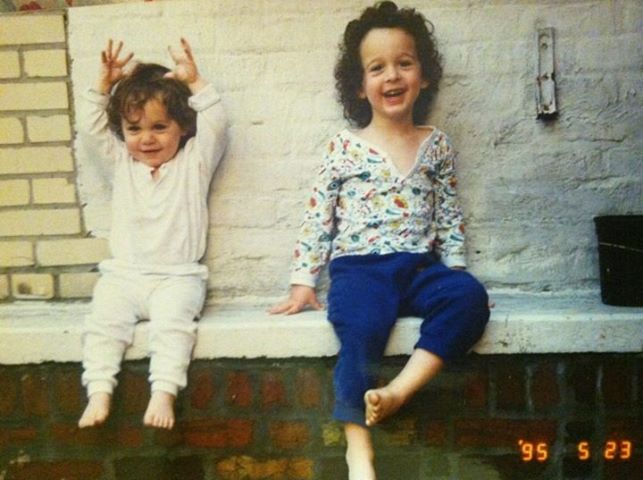
Natalie, almost 2, and Philip, 4

Natalie, almost 2, and Philip, 4

This is what our children give us. And no matter what, it’s with us always. Enjoy them; I know I did.

Two Years

Me and Philip, August 2012

Me and Philip, August 2012

Two years ago today was the last time I saw Philip; February 1st, as in 2/1 or 2/01 which will make sense if you read what I wrote here.

We went to dinner at the moderately expensive restaurant called Next Door, so named because it’s next to Blu, its older, more expensive sibling. It’s the omission of the “e” that makes you think it’s okay to pay up.

We ate, we talked. When we were done Philip asked if he could leave before the check; he had to get to fencing practice. Of course you can, I said. We stood to say good-bye and the restaurant became the stage where I kissed my handsome, 6’1” son for what would be the last time. Are you all watching, I thought; are you looking at this child of mine, this beautiful boy I mothered – me, I did it – and do you see what I see?

Turned out someone was watching.  I sat to wait for the check and the woman next to me smiled. “You always worry about them, don’t you?” she said. I smiled and nodded but truth was I didn’t worry. Philip and I were solid and if what was between us was right, what did anything else matter?

Then the unimaginable – that’s what came to matter.

© 2014 Denise Smyth

The Reason (Suicide, Part 3)

“I keep one foot out the door, and that’s suicide by increments.”
Rob (played by John Cusack) in “High Fidelity”

And that, right there, is the problem. I’ve a lead foot out the door and I think it’s soldered there. There’s an uncertain fear I live with and don’t care to define. Ed’s done it for me: “You are afraid to live because you think you’ll lose Philip.” But what does it mean to live, I want to ask him; show me how. He’d only shake his head because really, what else could he do? He can’t show me how to live because life isn’t given you by someone else, and if you think it is, it isn’t yours and you’ll wind up resentful, angry and either half-alive or half-dead, depending on the way you look at such things.

I keep thinking that living means having oh-so-many friends and taking fabulous vacations and talking on my cell when when I’m not texting on my cell and Facebooking, Twittering, Instagramming and “connecting” whatever latest way the internet’s figured out how to keep us glued to each other 24/7 because God forbid we should spend too much time considering. Life. Death. Meaning. WTF. It’s exhausting. But that’s not what Ed means by living. He means taking my foot out that door, which has to do with being, not doing. That still gives me only a vague idea of what it means to be in life. And what I see when I come close to sensing what living means is that I’m afraid if I’m not shaming myself, then someone else will do it for me. Somehow, that foot out the door feels like protection.

Hecht writes, “When a person dies, he does wrenching damage to the community.”  And, as Hamlet says of suicide, “ay, there’s the rub.” He’s talking of his uncertainty that death is any kind of end; I’m talking of what happens to those left in the wreckage of a loved one’s suicide, as well as the collective impact. Living carries responsibility with it, which includes taking seriously my effect on other people. I have to tell myself this because I don’t know it. I know I love Philip and I know I love Natalie; what I don’t know is how much I matter to both of them. Nor do I seem to “get” what I mean to other people.

And I think people who kill themselves don’t get what they mean to others. I’ve heard suicide called “selfish.” That’s a cruel, shallow, ignorant and cliched way to describe someone who’s in such devastating pain that it overwhelms consideration of anyone else. For  many, it’s almost like there is no one else because it feels like no one can help and no one really cares, not really. Because it doesn’t penetrate. Because  when you look around it seems like everyone else’s figured out this thing called life while I’m some solitary freak who can’t even find any other solitary freaks to commiserate with. I mean, what is it that keeps people wanting to live? It’s got to be love, doesn’t it? For people, for art, for work that is satisfying; for nature and its mysteries. That feeling of aliveness where you’re engaged in what you’re doing or who you’re with and there you are, being.  But what if you can’t feel anything but the lack of it all, the “Why?” that has no answer?

I can’t speak for anyone else, but my experience can’t be unique. I’ve wanted to die because I couldn’t feel love from anyone out there. I mean, I could feel love toward certain people – most deeply and particularly my children – but it didn’t feel reciprocal. When they were little, in my worst moments I would tell myself that I would kill myself when Natalie turned 16, because by then she wouldn’t need me any more.  She’d be well on her way (where the hell did I think she was going?), I’d be one more thing out of her way. Dead mom? Blip in the road, a stumble with quick recovery, then back to it like I wasn’t really there in the first place.

I believed this.

“We are all members of society,” Hecht writes, “and these connections are to be honored.” She says suicide creates more suicide. So I think about this. I think about the way Philip died – it was an accident. And I think of what I went through when I first learned of it, what I’m going through now. I was tortured; it didn’t matter that there wasn’t anything I could’ve done. I’m his mother – I was supposed to protect him. I was sick at the thought that there was a moment when he knew he was going to die, and he was alone and terrified but he had to let go. No way, I’m told; because of the heroin he went out in a blaze of bliss. I’m not so sure, but there isn’t anything I can do about it.

But as devastating as Philip’s death is, what if he’d chosen to killed himself? The things I hold on to are that he was a happy kid, that we were close, that there wasn’t anything unsaid between us. That I’ve nothing to feel guilty about unless I choose to make it so. But look at what his dying has done to me, to his father, to his sister – to all who knew him. The shocking, mindless blow of it. Do I think my own death would be any less shattering? What worse thing for Natalie than to live with a mother who’s not only dead, but dead by her own hand? So she not only gets to suffer my death, she gets to spend her life wondering why she wasn’t enough for me to live for.

And if I would do such a thing, in what meaningful way would I have loved her?

A few months ago, in my bathroom, I got a pain in my chest. It wasn’t about my heart – more like indigestion. But it caused me to bend over, and I closed my eyes, and made believe it was my heart. I might be dying, I thought. My heart might be shutting down and I might just keel over and Natalie’s upstairs, my God Natalie’s upstairs, I can’t leave her now, she’ll freak. She needs me to stay with her – I don’t want to leave her. So there was a crack in the atmosphere and I got it…but where’d it go? Do people live in full knowledge that they matter, they very much matter, to those who love them?

And so I have reason to Stay. But I’m missing the part about wanting to. I’m more attached to Philip’s death than Natalie’s life.

Next: What Philip says about that.

© 2014 Denise Smyth

1/20

Philip at 6

Philip at 6


I always sent Philip a text right after midnight to say Happy Birthday, so here I am. I don’t remember how it was last year, that first birthday. It was a Sunday, and Natalie took me horseback riding. It was a surprise; she knows I love to ride, and I hadn’t, not since the last vacation the four of us took together.

It wasn’t so much his birthday; it was the days following. I’ve found that’s when grief starts kicking my ass, in the aftermath. This year I’ve been walking in a white cloud of Philip. Walking along with pregnant-me, my belly full of him. Sitting with me on my bed, nursing him in wonder and stroking his soft, downy head. And seeing my 21-year-old son watching me, ever reminding me those moments are mine and not even his death can take that away from me.

I found this picture of Philip right after he died and I couldn’t bear it. You know why it’s so hard for you to look at this picture, he asked? Because you see the joy in me and you think you’ll never find it in you. I came from you, mom; if I have it, so do you. I do? Could I ever radiate, knowing what I know of death and loss and grief? I feel old in ways that are exhausting; I feel dirty next to his bright innocence. And guilty, that I now know what neither of us could, that he was only years away from the train wreck his life would end in.

I took today off because I think I would go crazy if I had to sit at work and pretend this is a day like any other. Birthday number two and I’ve not figured out how to mark it. What special thing there is to do. It seems it would be comforting to have a ritual, but I can’t think what that would be. Maybe I’m not to live a life of tradition; maybe I’m to learn to take it as it comes. Kirsten is making dinner for Natalie and me. Will you do this every year, I want to ask her? Can I count on you to always be here?

Let us enjoy our dinner tonight, let that be enough for now. Let me learn one by one that people love me, let me hold what I learn in my heart.

And let me, as Philip has asked, learn to find the joy.

© 2014 Denise Smyth

Sobbing and Useless (Suicide, Part Two)

Naturally the first (and as yet only) chapter of Jennifer Michael Hecht’s “Stay” that I’ve read is “Suffering and Happiness.” Because as anyone who’s tried to delve into what they suffer knows, lots of people have lots of things to say about the suffering/joy thing. I will not ask the one question that haunts: why? I mean, why the fuck does one have to suffer to know joy? Hell, I can even answer that in my own way – but it doesn’t satisfy, not really. But suffering transmuted can liberate me from believing that I must suffer. Can show me, if I’m honest, what my part is in what I feel. Like everyone, I suffer within the context of my life, and Philip is now the focal point of that suffering. But as I’ve said, he’s told me not to make his death into something it isn’t. I have to get my head out my ass first.

And what I mean by “suffering in the context of my life” is that Philip’s death is of a part of the rest of it. A really simple way to understand that is if you’ve generally been okay with being alive you’ll probably wrestle with your child’s death differently than if you’ve spent most of your life thinking you and those around you would be better off with no-you. I mean, one of the reasons I used to think it’d better if I died was because my insurance policy would pay for my kids’ college.

Think I had some of those self-esteem issues we hear talk about?

My cousin Maria remembers that when I was a kid I always loved gray days. They make me feel safe, I told her. Nothing’s changed. I’m looking out my window now, where the sun’s breaking through the clouds that just yesterday were full of rain. I’ve a pit in my stomach; they always leave, the clouds. Always. There’s more sun-time than cloud-time and it doesn’t seem fair. What I feel good about is temporary, leaves too quickly. What keeps me twisted is reliable. And that’s pretty much how life’s felt.

I don’t much like Hecht’s poem, “No Hemlock Rock (don’t kill yourself); there’s a certain silliness to some of it and I’m not sure what she’s trying to do:

Don’t kill yourself. Don’t kill yourself.
Don’t. Eat a donut, be a blown nut.
That is, if you’re going to kill yourself,
stand on a street corner rhyming
seizure with Indonesia, and wreck it with
racket. Allow medical terms.
Rave and fail. Be an absurd living ghost,
if necessary, but don’t kill yourself.

I guess she’s saying be crazy, do anything, anything at all except kill yourself; but those words have nothing to do with me because I’m hurting and and it’s too much effort to go out and get a donut and I don’t even know what it means to be a blown nut.

But “Stay” is something else. When two of Hecht’s close friends killed themselves, she wrote an open essay letter on a blog that she writes for.  “Life has always been too hard to bear, for a lot of people, a lot of the time,” she wrote. “It’s awful. But it isn’t too hard to bear, it’s only almost too hard to bear.” She tells us to sob and be useless because “Sobbing and useless is million times better than dead. A billion times.” She calls those who want to kill themselves but don’t, heroes.

I’m no hero. I didn’t kill myself out of fear; nothing heroic about it. And before I start going on about how cowardly I am that I didn’t, I’m going to switch gears. I have to start seeing things differently. I’m not into heroics, so I’ll just say I have some level of sanity or I’d’ve thrown myself drunk in front of one of our Montclair rail crossings.

But how crazy am I to be touch with Philip daily and yet want to die because he did? What is it about the dark that attracts me? Philip told me that he is my teacher where he is, and Natalie’s my teacher where she is. He’s here to show me what death isn’t; she is showing me what life is. But it’s Philip I listen for and yearn for and learn from; I don’t learn from Natalie. She’s intense and blooming and instead of learning that from her, I sit on the sidelines because I can’t have that. Too late, don’t know how.

How complicated is this all? Philip was my first born, and extraordinary to me. The first thing I’d done right; and when I saw the beautiful child he grew into, all the more proof of what I was worth. He was my light. Funny thing is, there were times I thought I was paying way more attention to Natalie than to Philip; but my children needed what they needed, and Natalie needed more. Philip was my steady. Lights don’t go out, I said when he died; they just don’t. “I didn’t go out, mom,” he says. “Have a little faith.”

See, I can bow my head every day in gratitude when he lets me know he’s near. But what good is it if I don’t learn to live. If I want to work with what he’s trying to teach me, then I have to be willing to follow Natalie’s lead.

Hecht quotes Ann Sexton: “I don’t want to live…Now listen, life is lovely, but I Can’t Live It. I can’t even explain…if you knew how it Felt. To be alive, yes, alive, but not be able to live it…I am like a stone that lives…locked outside of all that’s real…I wish, or think I wish, that I were dying of something for then I could be brave…to [be] behind a wall watching everyone fit in where I can’t…to live but to not reach or to reach wrong…to do it all wrong…I’m not a part. I’m not a member. I’m frozen.”

I know this. I know every word of this. I’ve said it all, down to wishing I was dying so I could be brave. So I am not alone. But this is what else I know: It does not have to be this way. I don’t have to be this way. I haven’t figured out what that means yet. But this is only part two.

Next: Suicide, Part Three

© 2014 Denise Smyth

Previous Older Entries Next Newer Entries