#3

Sunday was my birthday. Third one since Philip died. And maybe the most difficult.

My birthday is April 20th – three months to the day of Philip’s (1/20), and two months after he died. I quit my job when it happened. No way I could work. But a couple months later I decided to work one day a week for my friend Cindy at her law firm, which I could do only because to be around Cindy is to be around peace. If you tell me there’s no such thing as angels in this world, it’s because you haven’t met her.

The day I started work happened to be my birthday. I took a window seat on the bus to Manhattan so I could look out the window and cry. Those were the days when I could not comprehend or accept this world that acted like it always did, as if Philip hadn’t died. That world couldn’t see me, had nothing to do with me. All I could do was watch and weep.

When I got to work, there was a cake and a dozen chubby red roses on my desk. At noon, Cindy announced she was taking me to lunch. And at some point during lunch when she started glancing at her watch and looking for the waiter, I figured we had to get back because she had important lawyer-stuff to do. Instead she got the check and said we had to hurry because she had to get me somewhere by 1:00. She’d booked an afternoon at a salon for me – mani-pedi, hair wash and blow, facial, makeup. And when the manicurist sat me down I said, “Listen. I’m not going to be able to sit here without crying and I thought I should tell you.” When I told her Philip died she burst out crying and told me that her son had died. None of that was planned, but it certainly made it easier.

And if all that wasn’t enough, Cindy paid me.

I wrote about last year’s birthday here. I spent the day with Natalie – it was a quiet day, and we were together, just the two of us.

This year my birthday was on Easter. My mom celebrates Easter Saturday, the day you break the fast from Lent. “I’m getting a cake for you,” she told me. “We’ll sing Happy Birthday.”

No fucking way. I do not want to sit with my aunts and uncles and cousins and have them sing Happy Birthday to me. “But we have to sing, Denise. Everybody’s going to want to.” Then it hit me that the attention I was trying to avoid was going to turn into an attention I wanted even less. If they sing, it’ll be over. If they don’t, there’ll be whispers and worries. There was a time I wanted that attention – any and all, I’d take. Because you had to know about Philip. That was – that is – the essential fact of my life.

Someone I know wrote me a letter and said he knew I didn’t want to be known as “the woman who lost a son.” But I am a woman who lost her son. That is the first, most thing you need to know about me. And if in ten years or twenty years or six months or tomorrow that changes, then it changes. But right now, whatever else you know about me, you have to know my son died.

My family sang and it wasn’t so bad. But next day, my birthday, I woke up in a rage. It’s my goddamn birthday. I was supposed to go to Cindy’s, but I couldn’t go out. Natalie went out with Phil, and I laid on my couch and spent the day watching “True Detective” for the third time. I got up to eat, to pee, to walk the dogs. I got up to brush my teeth, but I could still taste the bitterness.

I know the other side to grief is love. And I do love Natalie. But still grief overwhelms, seduces, feels hard and familiar. It’s my Dark Passenger. And as Toni at Wasted Times wrote, “It doesn’t seem right to celebrate what they have lost.”

© 2014 Denise Smyth
“Hand to God”

A couple Sundays ago Kirsten took me to see a play, “Hand to God.” It was set mostly in a church rec room, and had five characters. Seven if you count the puppets. Three were teenagers – Jason, Jessica and Timothy, – one was the pastor of the church, the other was Margery, Jason’s newly-widowed mom, who was supposed to be teaching the kids puppetry. Jason was there because Mom insisted, Timothy was there while his Mom went to twelve step meetings, and Jessica was there because, well, she was “more into Balinese shadow puppetry,” but she’ll take what she can get.

But the real star of the show was Tyrone, Jason’s evil demon hand puppet. Jason steadily loses control over him – Tyrone even shows up in Jason’s bed after he takes him off one night. “He’s making me do bad things,” Jason tells Margery. Jason is a shy, troubled kid, and Tyrone becomes his mouthpiece. If Jason’s thinking it, Tyrone’s saying it. And if you’re thinking anything with a puppet or two is silly, it’s not so funny when Tyrone bites a bloody chunk of Timothy’s ear off. Or when, in desperation to be rid of him, Jason starts hacking Tyrone – in other words, his hand – with a hammer, and accidentally smashes his mother’s while he’s at it.

To paraphrase Tyrone – “self-hatred’s a bitch.”

Anger and lust drive the play. The pastor wants to sleep with Margery, who rebuffs him. Timothy also wants to sleep with Margery, who doesn’t rebuff him. Jason is smitten with Jessica, and Tyrone lets her know in his vulgar way. And before the show is over, Jessica’s puppet will have dirty puppet sex with Tyrone.

Two weeks later I’m still thinking about that play. That’s what happens with art, when you see yourself in it. Jason’s overwhelmed by his rage at Margery for being a shitty wife and mother. I’ve lived overwhelmed by rage, and my version of hammer-smashing my hand was drinking, vomiting and refusing to take care of myself, some of which I talked about here and here.

 There’s so many levels of disturbing in “Hand to God” that it’s hard to parse – not the least being the tragic hilarity of it all. Everyone – with the possible exception of Jessica – was unhappy and none of them knew what to do about it. And when the play was over, there wasn’t any resolution. Margery and Jason can bond over their mutually bloodied hands, but that won’t fix the history between them. And in spite of his viciousness, I felt like I lost something when Tryone was killed off before the end of the play, when there was nothing but the “real” characters left. But after the lights went out and the players disappeared, a spotlight shone above the stage, and there was Tyrone. Miss me? he asked; C’mon. You know you did.

What’s up with that? I couldn’t be the only one glad to see him. Tyrone the Terrorist was seductive and exciting. He was the best thing in a play filled with terrific. But I want to know why. I want to know why I’m so drawn to the dark side. “I don’t think I liked the play so much,” Kirsten said. “I really didn’t like what Jason did to his hand.” It bothered her – she has a limit to how far down she’ll go. Where’s my limit? What am I looking for in that dark? I believe that’s where I’ll find something real. Something raw and primal and so far down I can scream until I exhaust myself numb.

“You have to learn to like the light,” Philip tells me. He doesn’t say “love” – that’s too much right now. I’m drawn to gray days, to rain and thunder, to storms which don’t happen often enough. Melanie told me there’s a word for that – pluviophile. Lover of rain. I don’t think there’s anything to learn from lightness. I’ve been watching a lot of TV series, a lot of movies, and it’s making the way I experience life clearer. Entertainment is either a black or light image to me. When I hear “chick flick,” I think Waste of Time. When I hear drama, I’m seduced. I want the treachery – give me “Pulp Fiction,” “American History X,” “True Detective,” “Requiem For A Dream.” Let something besides my own morbid thoughts bring me to that darkness because if I see it outside of me I won’t be so alone with it – and maybe somewhere in that depravity I can figure out how to live with grief and death.

In “True Detective,” Rust says that with humans, “nature made a tragic misstep in evolution.” I thought about why someone would say that. And what I thought was how hard it is to be here, even if you get through without a major tragedy. First off, we live knowing we’re going to die, and since we don’t know what happens when we do, it’s terrifying. And it’s not only our own death we have to deal with. People we love will die, which can be a worse thing to suffer than any nightmare we might have had about dying ourselves. Then there’s the fact that we need each other, yet it’s so hard to get along. Especially when we’re wanting to be right more than we’re wanting to be loved. The world’s like a big refracting mirror. Our personal arguments are reflected in larger social arguments, which are reflected in even larger political arguments, which often culminate in the most massive, monstrous argument of all – war. If we take a look at what’s going on around us, it’s clear that as a species, we’re insane.

We deal with our tragedies in the context of the way we live, which means crisis brings out the past. So when Rust says we are mistakes of nature, that’s what his life has brought him to. What do I bring to my suffering? Philip’s death is my Sisyphus. The shock of it hurled me back to some personal, primitive beginning that I thought was long gone. But that’s the thing – life isn’t linear. It’s now, it’s all happening now. I brought the grief of a lifetime to Philip’s death. I’m torn and twisted and it’s hard to untangle the grief from the drama. When Philip said, “Don’t make my death into something it isn’t,” he meant don’t bring the past into this. And much as I’m talking about the void I’m attracted to, Philip’s in a light so profound I can only pray to have a glimpse of it. That’s the light that burns the past out of us, the light that leads to the Divine. And burning “the past out of us” has nothing to do with forgetting. I’m talking about a psychic past where we react based on the self we’ve created and so stay stuck in our stories. To burn the past out is to bring a freshness and wonder to whatever is now, including death and grief. And that doesn’t mean happy – it means clarity.

So on the one hand, I say I need the dark to understand death. On the other, I say it’s light that leads to transcendence. Do I even know what the hell I believe?

There’s so much I don’t understand. There are people who, after their child has died, reach a point where they find life more precious than ever. Is it because they loved life before, and so now appreciate its brevity the more? When I was a kid, I loved music. My parents gave me a transistor radio in a brown leather case that went wherever I did. When my mom would get mad at me, she’d take my radio away. She took a piece of me with it. “Didn’t you want music even more, when your radio was gone?” my therapist asked. So loss of something makes you want it more. But how’s that supposed to translate? Philip’s death has made me want his life more, not mine.

More, next…

© 2014 Denise Smyth

One Year

March 31st was my one year blogging anniversary. I wanted to write something then, but I didn’t know what. And I’m mostly writing this because I’ve been working – grappling? – with the post I’ve been writing for the last week and a half, and I’m feeling kind of disconnected from not posting for this long. It’s coming together, but it’s hard for me to get down what I’m trying to say. I’m still figuring it out.

Blogging’s connected me with so many people – and it keeps me connected to myself.  I don’t know how I’d get through this without it. I have to keep talking about Philip, about his death – one year of writing and I’ve still so much to say. If it was all just rattling around in my mind instead of being written on a page, I’d be a kind of crazy I can only imagine; curled up under the covers, eyes closed, holding my breath while I waited to die along with my son. So I’m saying, with much gratitude, thank you all for helping.

A few people have made some noise about me meeting someone. It would be good for me, they say. And right around that time, all-of-a-sudden I started getting Match.com invitations ;o) I think that if I cared for someone, if someone cared for me and I could take it in, that would be good. But I’m not sure I have the energy for that kind of effort. Philip’s death is so much with me – and anyone close to me has to know that. The friends I spend time with know that. So to meet someone, to go through that awkward first date – I’m not there because I’d have to sit down and say, “You have to know my son died, you have to know I’m suffering this,” and that just doesn’t seem like first-date conversation.

The conversation I want to have is the one I’m having right here – so back to what I’ve been writing, and I’ll “see” you all soon ;o)

What I Write

Lividity is when someone dies and the blood pools in their body based on the position they’re in. The skin turns dark. Philip was dead in his room for two days. He was lying on his back when his friends found him. One of the things I tortured myself about for months was thinking about what his body looked like, how all the blood had pooled on the back of it. I wished I’d never heard of lividity.

I knew that body wasn’t Philip any longer but it didn’t matter. I cried to think he was alone in his room for two days, to think that maybe he realized he was going to die and he was frightened; to think of him being handled by other people, put in a body bag, lying in the morgue. And now – I can look at it like he’s left this world and doesn’t get to live his life. Or I can look at it like he’s woken from this dream and so is spared the grief.

I’m grateful I wasn’t the one who found Philip. I used to wonder why we never see what a dead body really looks like, why the guy at the funeral parlor fixes them up first. You know what? Thank God. If I had to look at Philip in a coffin, better he looked like himself than what he looked like when his friends found him.

I thought about this because of an essay I read, which I’m linking to here.

My last post was a link, and I was about to end this one the same way. That’s not like me – and not that there’s anything wrong with linking. These two posts are just that good. But two in a row, plus not posting for two weeks, had me wondering, “What’s up with that?”

I started a ten-week writing class in January. It was hard to work on the assignments, as well as blog. Not because I didn’t have the time. Time doesn’t equal energy – I can only write for so long. And going from essay to blog post and back again was no easy transition. That would’ve been enough to deal with without my increasing frustration with the class. I had some real problems with V., the teacher. But that’s not the point. The point was I waited nine weeks to tell her what was going on. I acted like a resentful child, pleading sick when I didn’t want to go, until I went as far as I don’t want to write that assignment, and you can’t make me. And it’s not like I didn’t see what I was doing. I was paralyzed all the same.

Sometimes I think that since Philip died, what the hell else could bother me? Sometimes I think things bother me more because my emotional immune system is whacked. One thing’s for sure – his dying doesn’t give me a free pass. The things I was trying to work out before he died still have to be worked out. Like what went on in that writing class.

I’ve written about the way we take a situation – a set of facts – and turn it into a story where we’re writer, producer, executive director, star and victim. So if we see what we’re doing, we can stop, right? It’s that simple, but it isn’t easy. Some of my stories are old as I am, have a life and momentum of their own. It’s beyond thinking – my body gets involved. In fact, I’m not exactly aware of what I’m thinking because I’m consumed with reacting, wrung out and twisted and so terrified that I’m confused about what’s really going on or what to say about it.

So with V. I turned the problems I was having with her into she didn’t like me, wasn’t paying attention to me, wasn’t giving me what I needed. Blaming her rather than taking responsibility. Continuing the class with some secret hope that next time would be different, walking away pissed off and disappointed when it wasn’t. But why would it be? It was my version of “Ground Hog Day ” – doing the same thing over and over and thinking it’d turn out differently.

It didn’t help that I started class by announcing I wanted to use the assignments to write about something other than Philip. Did I forget who I was, who I am? That was a ridiculous and unrealistic pressure to put on myself because I do not want to write about something other than Philip. And what I write isn’t about “Philip.” It’s about me. What his death has done to me, what it feels like to live in the aftermath. This is hard, hard stuff. Writing’s a way I abide it. When I can abide it at all.

When writing is an assignment, it becomes a “have-to.” And it’s fine to say as a writer, I should be able to finish something when I have word count or a deadline. But I’m not living in a world of word counts or deadlines. I’m living in a world without. I don’t recognize it, I don’t like it, I don’t want it. When I’m with my daughter, when I’m at work, when I see Kirsten or Harriet, when I write – I crystalize. I feel it all, all of it. But then I’m driving or walking the dogs or sitting on the couch alone and it’s like trying to stand up in a rowboat during a monsoon.

It took nine weeks – as well as conversations with Ed, Kirsten and my daughter – for me to get the nerve to tell V. I wasn’t going to the last class.  “I’m like a child,” I told Natalie, who tilted her head and stared at me with a face full of  are-you-kidding-me?  “What do I say?”

“How about that class isn’t helping you?” she answered.

Result? V. and I talked about what was going on, and while I still didn’t go to the last class, I was out of the drama around it. In other words, I realized V. was not my mother.

And as far as what I write about, V said writers write about what they can’t stop talking about. I’d say we write about what we want to keep talking about but have to stop talking about because nobody wants to listen. So we write for others to read because we need that connection. I’m not saying “nobody” wants to listen to me about Philip. But it’d be impossible for anyone to listen to all I need to say, as impossible as it would be for me to keep talking. My throat would be scorched from the all of it.

It’s not for me to say, “I’m not going to write about Philip.” This is my need. For now, the writing is writing me.

© 2014 Denise Smyth

Save yourself: write now, tomorrow, or whenever

I thought this was too good not to share. “One needs to grieve almost to death before they can live again.” Yes, one does.

Every Story

Can I sail through the changing ocean tides?
Can I handle the seasons of my life?
“Landslide” by Stevie Nicks

Where does anyone turn to answer those questions? Because I’ve a sickening feeling about the season my life’s turned into, the one about moving on without Philip. I don’t mean “moving on” as in “getting over it.” I mean life is motion and where life goes, so go I. And I don’t mean – really – “without” Philip. I’ve said much about the way he communicates with me. But I’m facing his death, the loss of his physical presence, and I’m weak in the knees once more.

I am in need of spirit, and I’m still asking myself how to find it, though I know the answer is within, not without. I’ve done enough searching to know I’m not going to find it through a go-to guru – Louise Hay, Wayne Dyer, Deepak Chopra and Madonna and her Kabbalah included. Don’t ask me what any of them are talking about – that they’re on TV giving the rest of us their version of spirituality is enough for me not to listen. My big turn-off to New Age “spiritualism” came after reading something or other Louise-Hay which had me walking around “affirming” over and over what I thought I wanted and having a pit in my stomach while I was doing it. Whatever I wanted wasn’t happening, and trying to convince myself that it was, wasn’t working. Then I saw Ms. Hay on a talk show. It took a few minutes of her one-size-fits-all earnestness to realize no one thing works for everyone, but when some one thing works for someone, they sure like to tell the rest of us about it.

I’ve found some sense in Eckhart Tolle’s writing. When I first saw “A New Earth” in my friend Rebecca’s yoga studio, I thought, “Another book about saving the earth? Most of us can’t even save ourselves, never mind the environment.” And while I’d jumped on the green-is-better bandwagon way before it became chic and expensive to do so, I was sick of the moral indignation that made people care more about the air quality than they did each other.

But a few years ago, when my normal depression had spiked into crisis-mode, my friend Melanie told me Eckhart Tolle was a spiritualist, not an environmentalist, so I bought “A New Earth” on CD and drove around listening to it. It made a whole lot of sense. But I didn’t come upon Tolle in a vacuum. For years I searched for some sort of spirituality through AA, A Course in Miracles and Buddhism – to name a few. Then came the years of not searching for anything at all because it was too damn hard to find something when I wasn’t really sure what I was looking for.

But the stopping was just as important as the searching. I wasn’t grasping for something any more. I wasn’t at peace, either. Tolle came into the spiritual silence I’d been in, and what he was saying was an amalgam of all that I’d practiced before, in language I could understand.

Of course, considering him a teacher made it easy to go right back into the unconscious I was trying to wake up from. Yeah, yeah, yeah, live in the now, present moment, the past is gone, life doesn’t end, etc., etc. So I’m sure I’ve already heard Tolle say, “Every story ultimately fails.” But when I heard it the other day, I stopped the CD to think about it. I’ve been thinking about it for days now, and taking what comfort I can from it. Which isn’t much at the moment, but there’s something there that feels like truth, and no matter how hard a truth is, accepting it is better than arguing with it.

That every story fails is hard to hear, but it’s not a negative assertion. Stories “fail” because they involve form, and all forms are temporary,  are disintegrating even as they’re existing. That includes “thought” forms. Meaning, like, say I think of myself as a really important artist and I create all these wonderful paintings that everyone agrees are phenomenal and then one day I wake up blind. My thought of myself as an artist takes a terrible blow – who the hell am I now? My story as important artist ends and I have to make up a new one. Or not make up one at all, and just try to be. Because every time a form dissolves – whether it’s physical or mental – it leaves an opening to God.

And I use “God” to mean whatever it is you might think is divine in life. Whatever you think is more than you are, whatever force you think there is in this world. The Divine needs space and attention, and we can’t give it that if we’re only concerned with accumulating forms that we think will show both us and the world who we are.

But stories can have truth and beauty, and that doesn’t change when the ending does. And what I mean by story is what we tell ourselves about our lives, instead of living them – the stories about the way things are or were or should be, about what any of it means. Like, So-and-So walked right past me yesterday without saying a word – she’s such a shit. Or, So-and-So walked right past me yesterday – I’m such a shit.

Maybe So-and-So didn’t see me. Maybe So-and-So is suffering and preoccupied. Maybe So-and-So really can’t stand me. What does any of that have to do with me?

And ultimately, both So-and-So and I are going to die. Where’s my story then?

There’s nothing “wrong” with form – it’s our attachments that hurt us. We can enjoy the world of form – through it, we can sense the deeper joy and beauty that is as much a part of life as the terrible grief it seems easier to feel. How many times did I wear that dress before I tore it where it can’t be fixed? How many places did that car take me before it was too old and worn to do so any more? How many days, months, years, how many hours did I take joy and pleasure in  Philip before he died?

But it wasn’t enough. Philip is my child. In my story, he goes on to find work he loves and a woman he loves and they have kids and Natalie and her partner have kids and even though I’m alone I’ll always have somewhere to go and maybe I’ll let everyone else cook Christmas dinner while I sit by the tree and play with my grandkids.

But Philip went and died and half my story is gone and I feel like half of me has gone along with it. What he’s left me is that opening to the spiritual, which I can define as simply learning to see things differently. This is where it gets hard. Really hard. Because the stories we tell are to invent a self. That’s why when one of them disappears it can cause a crisis. And while in so many ways I understand this, where the fuck does that leave me with Philip? In essence, the work is no different: How do I live in the face of loss without feeling diminished?

The short answer is, one breath at a time. And while some part of me knows that, some other – bigger – part of me sees that as just words on a page.

© 2014 Denise Smyth

What I See

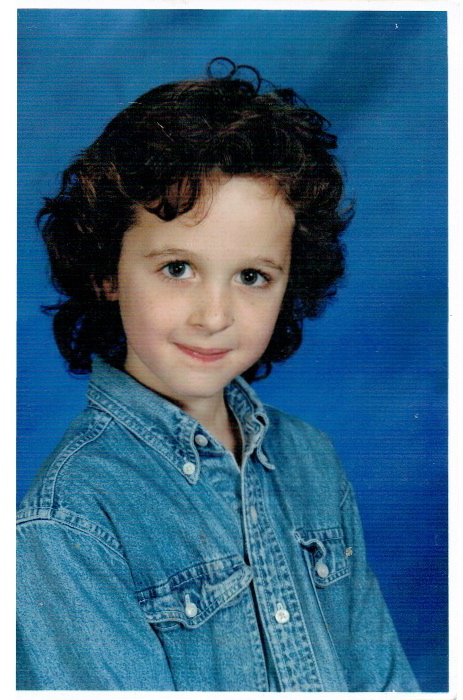
Philip at seven

Philip at seven

Last week I walked into therapy, sat down and made an announcement.

“I want to have a baby,” I said.

“What you need to have is a man,” she answered.

First off, in case you’re wondering, the baby ship sailed about five years ago. Second, that’s not exactly what my therapist said; she’s way more subtle and nuanced. But it’s what she meant, and it’s not about being saved – it’s about what I need and how I take care of myself.

It’s not just having a baby. I want to feel the fullness of pregnancy, I want to walk in the world belly-first. I want to use words like holy and sacred and cherish and tell you I’m on hallowed ground because that’s what it felt like to carry my babies. I want the peace and wonder of those all-too-short nine months. Twice in my life, I used to think; only two times in a whole lifetime do I get to be pregnant. And maybe I’m remembering all this in a blue haze of sentimentality, but I’m longing for Philip and it’s making me crazy.

The need I feel doesn’t seem to be for a man; but I suspect I’m needing to hold and be held, and it’s easier to feel it for a child than an adult. Hence maybe it is for a man. But I can’t see it, not the way I see my child’s gaze, my child’s sleepy arms around me when I carry him to bed. I can’t see it. I’m an adult. If I’m yearning to be held, then I have to think about how that happens. I’m never going to be pregnant, not in this life. If I have a need, I have to figure out a realistic way to meet it.

I don’t know how I got on to that whole thing when what I wanted to write about is what I see when I look at that picture of Philip, and how there are times when I feel like his death is killing me softly and slowly. I try to write truthfully, to stay away from sentimentality, from victimhood. But when I look at this picture – and for some reason I’ve been thinking about it and staring at it for days now – I see an angel and I remember what a sensitive kid Philip was. I remember the way he used to toddle after me, even into the bathroom, how he’d cry if I closed the door. And I loved it because I knew it wouldn’t last. I remember the poem he wrote in second grade, where he named all his friends, but ended by saying that I was his best. I remember the day when we first moved to Montclair – he was seven, like he was in the picture – and I looked out my window to see him in front of our house, leaning on a telephone pole, watching my neighbor’s kid across the street. Jimmy was a year older than Philip. He was on his front lawn playing with what looked his entire little league team. Back and forth I looked with a tight stomach and sagging heart, knowing Philip wanted to be invited over, knowing that if they were letting him stand there, he wasn’t going to be.

But Philip got himself into that, and he’d have to get himself out of it. What parent doesn’t wish they could protect their kid from any-and-every-thing? But we can’t – and if we think about it, why would we want to? Because sooner or later they’re going to be on their own, and what then, if they’ve never figured out anything by themselves? And how does one live more deeply and with meaning, without having had to move through suffering in some way or another? Because not only don’t we get out of here alive, we don’t get out without grief.

When I look at that picture I see Philip at nine, at a pool party with his friends and their families. I see him coming over to me and Phil crying, because his friend Tim pushed him. He didn’t understand why Tim was mean – that’s what got to him. One by one the kids in the pool began looking our way and whispering. It’s that pack mentality that senses weakness – it’s the scent of blood, and they were circling for the kill. Philip’s weakness was wanting to belong but not feeling he did. Plus he broke the unspoken rule of not “telling” on another, a sin with a hard recovery.

Phil went to speak to Tim’s dad, who told him Philip should have pushed back. I think nine is a good time to tell your kid not to lay your hands on another kid if it’s not self-defense. But what do I know of a boy’s world? What I knew was my son was crying and everyone was watching. And what greater humiliation than to be the shut-out of the group, to be the kid leaning on the telephone pole, watching.

When we got home, I knelt down to talk to him. “Philip, look,” I said, “I don’t care if you cry. But those kids aren’t going to be nice to you if you do. Maybe you could try really, really hard next time not to cry, and just tell yourself you’re going to wait until you get home. Because here you can do what you want. Go in your room if you have to. Cry, yell, whatever. But don’t give them any reason to make fun of you.”

I was begging him, really, to let it go, because then could feel better. You know how it is – your child doesn’t hurt without you hurting right along. But it didn’t work. Philip was upset and didn’t say a word. So I stopped talking and stepped back because this was something else he was going to have to puzzle out on his own. And I had to trust that he would, and that both of us were going to be all right.

And that’s not all I see, but it’s all I’ll talk about for now.

© 2014 Denise Smyth

1/20/91 ~ 2/23/12

It’s no exaggeration to say that I knew the worst moments of my life on February 23rd, 2012. One of the first things I thought when Phil told me Philip had died was, “Right now, this very second, there are people all over the world who are feeling like I am right now. And if it is possible to feel like this, what is the point of being alive?”

Many of you know exactly what I’m talking about. And all of you are helping me, every day, to find some “point.” You have shown me love and so taught me gratitude. Because without love, without connection, there is no point.

I thought that instead of writing something today, I’d scan a bunch of pictures of Philip and post them, but that didn’t feel right. For  reasons I can’t yet figure out, posting that last picture of Philip and Natalie sent me spinning into despair. Then I thought I’d post some quotes from an anthology  I have of writers and poets on losing a child. Except I read so much of that book today that I started to drown in it all, which meant I wasn’t breathing and the world was turning into the color of death.

I haven’t much to say. It’s quiet time now. But I wanted to mark this day somehow, so here it is. And I’ll end with just one quote, which pretty much sums it up:

“I love the boy with the utmost love of which my soul is capable, and he is taken from me…yet, in the agony of my spirit in surrendering such a treasure, I feel a thousand times richer than if I had never possessed it.” ~ William Wordsworth

RIP Philip – my love, my heart, my son.

© 2014 Denise Smyth

Yesterday, Today, Tomorrow

What fierceness to say, “I will never accept this.” What comfort is mixed up in that, knowing I’ve taken a stand. What despair is at the core of it, because not to accept what is, is a form of insanity. I can be as angry as I want, but that won’t change what is so. When I carry around anger about something I can do nothing about, it’s because I think anger is going to get me what I want. Why else remain angry? Why else tell myself the story of what happened so that I wind up the victim? What happens when I realize that I’ve taken some fact of my life, an event that happened in time, and told myself an unhappy story around it? Then I see how I keep alive the ghost of  the past and so miss my life, which is only ever happening now. Not in the past, not in the future. Now. But the voice in my head insists otherwise.

And if I think my anger isn’t an attempt to get something I want, I can think about the way I feel about letting it go. It’s  like if I’m not mad, then I’m saying something’s okay when it isn’t, and what an outrage that is. If I’m not mad, that person/institution/whatever gets away with “it.” How humiliating for me; if I’m not mad, I’ve lost.

Except that isn’t it, not at all. If I’ve let go that anger, it’s peace to me. It’s freedom. It’s not my job to see that someone doesn’t get away with something, as if anyone “gets away” with anything. An unconscious life is its own prison. Truth will out, with no help from me.

A year ago fall, the first fall after Philip died, I went outside one brilliant morning to walk the dogs. I lived in Montclair, known for its massive, shaggy trees. Four years I’d been living on that particular block, walking past one particular tree, and that morning I witnessed its transformation. The sun lit that tree and it shimmered red and gold; it was glass on fire, and if it could have  made a sound, it would’ve been celestial. This was shock and awe, I thought, as I stood staring up at it. Are you seeing this, a man yelled to me, from across the street? I couldn’t take my eyes off it to answer.

If I could live in that light, I thought, if I could just not move and stay right here, I will be all right and it will all have been worth it. Which is right about when my mind rushed in and reminded me that I’d caught a moment that would be gone in another, and I’d probably never see another one like it. Ever. What was the point, then? What was the point of having my breath taken away only to have it return with its disappointments and hopelessness?

It wasn’t enough because in some fundamentally human way it’s never enough; it’s the grasping, needy edge of ego that wants to want more than it wants to have. No having is ever enough, not when having something becomes essential to our identity.  If our reality is based on having, then that reality must be false. What can we possibly have that won’t turn into something else? After it disappoints us, first. Where’s the reality then?

It’s easy to see what I’m talking about if you look at the objects that once seemed so necessary to a happy existence. I had to have those pants and make it two pair, since that’s safer. In case one wears out or something. Or that car or house or earrings or lover or body size or whatever external thing will confirm the reality of me as I perceive myself. It’s not that hard to see the objects I’m attached to and begin to move away from their power. And of course we all need things – I’m talking about the attachment to those things, to the way they become part of our identity, the way we feel diminished we lose something, when it breaks, when it gets gone like all and everything eventually will.

But what happens when I think about attachment and loss in terms of relationships, of actual people? I’m 55. I have years behind of me of people – of romantic relationships, in particular – that I believed I had to have or I couldn’t go on. But their time passed, too; and from this view, I see what I wanted from them, how much of what I called “love” was grasping and clinging; how the wanting, in the end, drove me more than the having.

But then your kid goes and dies and you wonder where the hell you’ve been all your life because there isn’t anything that feels more real than the grief of losing them and the contemplation of living the rest of your life (we talking 20, 30 years? You fucking kidding me?) without them. What of all I’ve just written, I think? What of attachment, of wanting, of having, of disappointment, of anger? I am speaking of my child now, not the two pair of jeans I finally tossed into the giveaway pile. How now?

Mom, Philip says, when you think of me, you think of me in a long dark tunnel. It isn’t that way. Think of me in the light you saw in that tree, only infinitely brighter, and you’re closer to the truth. The truth? That’s what I’m trying to figure out here. Truth doesn’t change – in the world, it’s relative. But in stark reality, it’s unchangeable. Else it wouldn’t be Truth. So how to think about these truths in terms of Philip? When is “having” enough, and what do I mean by that? In essence, I have not lost Philip. In fact, I’ve never felt closer to him or more certain that he’s around than I do now. I ask, he answers. He leads, I follow. He talks, I listen. And all any of that requires is turning my attention to him.

I dreamt of Philip a couple weeks ago – twice in one night. In the first, he was running up the stairs, “Philip!” I called. He came down smiling. “Why didn’t you tell me??” I asked, in shock. “I wanted to surprise you,” he said. In the next, again, I saw him. This time he looked confused. “Philip,” I said, “Where have you been? I thought you were dead!” “I’m not,” he said. “But where were you for two years?” “I don’t know,” he answered. “But I saw you in the coffin,” I said. “I know,” he said. “But I got up afterward.”

I’m no interpreter of dreams. So I went to the source. What was that about? I asked Philip. I’m trying to get your attention, he answered. Because for these last few whatever, I’ve been thinking about him instead of listening to him. I’ve been looking at a world where dead means dark, stark silence instead of seeing the startling ways he lets me know he’s around. It’s time to start working, he said to me. I’m here, but you’ve got to do the work.

If I’ve jumped around here, I’ve no doubt I’ll be sorting it out as I go on. Yesterday was two years since the last day Philip was alive. Today was the day he lay dead in his room, and no one knew. Tomorrow was the day we found out, the day on his death certificate, the “official” day he died. These two years seem to have passed quickly. I’m grateful. Because I’d rather wrestle with my grief as it is now, instead of as it was then. It’s not gone, for sure, but at least it’s different.

© 2014 Denise Smyth

Too Rare, Too Quickly

                      “…Curse only
the fact that such days are too rare
and pass too quickly.”
Grace Bauer from “Nowhere All at Once

That’s from a poem we read Wednesday night in my writing class, in anticipation of yet another snow day here in NJ. I’m about the only one I know who’s loving this weather. I look for its excuses to stay inside; I look for it the way others look for spring. I resent spring’s incessant blooming, its insistence that I be outside. What all am I supposed to do out there? Inside, there are curtains to sew, movies to watch, books to read, words to write. And stillness to inhabit, because all the sewing, watching, reading and even writing are not going to teach me how to live with Philip’s death if I can’t spend some time still and silent.

Natalie and I live on the top floor of a two-story garden apartment. Our unit is part of a brick building set back from the sidewalk in a small u-shape. When I look out my living room window, the bottom of the U is to my left, and I face the side of the U opposite mine.  In the center lawn is a large, wide evergreen; on Thursday, its trunk was disappearing under the same snow it gracefully shook from its branches, with some help from the passing wind. Snow was coming off the roof in delicate powder-puff bursts, which weren’t at all delicate when I stood underneath them – then they were a chill hail of icy needles aimed at my upturned face. Not unpleasant, really, unless I stood long enough for the chill to take hold. Because if it did, it’d work its way under my skin and I wouldn’t be rid of it easily.

By 1:00 I’d come inside for the fifth time. I was restless and uneasy and kept going outside to breathe icy air, to make sure the snow was as real as I wanted it to be. It was up to my knees and I didn’t want it to stop. I was all-too-happy to fall asleep the night before, knowing I’d wake up to that snow. But there it was and I watched and waited but for what, I didn’t know. The flakes kept shrinking and growing and I dreaded their cessation, afraid they were going to stop before I heard what they had to say; if I didn’t hurry up and get their message, it could be for-ever until they came again

“The universe is talking to you,” Ed says, every time I tell him some new way Philip’s let me know he’s around; “What more do you want?” I could be flip and say, “I want my son not-dead,” but that’s not what I say. That feels false, and I don’t mean because I don’t want Philip here. I mean that’s a glib, thoughtless response, designed to cut Ed off and leave myself alone and misunderstood. Why do I tell Ed these things, why tell anyone, if I’m going to diminish them to prove that grief trumps all. And what then? I win?

I looked out my window for hours on Thursday, looking for something in the brooding silence of the storm. But then it stopped and the sidewalks and walkways were snow-blown into 18”-wide perfectly-edged mini corridors. The snow I’d trudged through earlier that day had been tamed into something more manageable.  But I wanted more; the world wasn’t yet white enough. The bushes were still visible, and that tree looked no more covered than a woman in a sheer lace top. Why can’t we abide the quiet? Why the rush to order, to busy-ness; the hurry to get back to what’s familiar, to what we think life should be? The way it is is the way it’s supposed to be. How do I know? Because that’s the way it is. Complain about the snow, the rain, the cold – each serves its own purpose. How much more peaceful to recognize that than to insist that life’s not fitting the story we want it to.

And if I really think life’s the way it’s supposed to be, then I need to accept that Philip’s not here the way I want him to be, to respect the way the universe is talking to me through him. I need to move past the stamping-my-feet phase of my grief and see what it means to live in its depths, always with Philip guiding me. “In life,” Philip says to me, “you said the more you let go, the longer our bond became. Nothing’s changed, Mom. And whatever you’re afraid of isn’t binding us any tighter. It’s just causing you to miss what it is I’m trying to tell you.”

Try some happy, Mom, Natalie says. So here’s some 24 hours of it. Enjoy.

© 2014 Denise Smyth

Previous Older Entries Next Newer Entries