I thought this was too good not to share. “One needs to grieve almost to death before they can live again.” Yes, one does.
Save yourself: write now, tomorrow, or whenever
17 Mar 2014 4 Comments
in Death, Death of a Child, Faith, Motherhood Tags: bereavement, death, death of a child, faith, grief, grieving, loss of a child, motherhood, writing
Every Story
15 Mar 2014 26 Comments
in Death, Death of a Child, Faith, Motherhood, Uncategorized Tags: #WPLongform, AA, bereavement, death, death of a child, depression, Eckhart Tolle, faith, grief, grieving, loss of a child, motherhood, spirituality
Can I sail through the changing ocean tides?
Can I handle the seasons of my life?
“Landslide” by Stevie Nicks
Where does anyone turn to answer those questions? Because I’ve a sickening feeling about the season my life’s turned into, the one about moving on without Philip. I don’t mean “moving on” as in “getting over it.” I mean life is motion and where life goes, so go I. And I don’t mean – really – “without” Philip. I’ve said much about the way he communicates with me. But I’m facing his death, the loss of his physical presence, and I’m weak in the knees once more.
I am in need of spirit, and I’m still asking myself how to find it, though I know the answer is within, not without. I’ve done enough searching to know I’m not going to find it through a go-to guru – Louise Hay, Wayne Dyer, Deepak Chopra and Madonna and her Kabbalah included. Don’t ask me what any of them are talking about – that they’re on TV giving the rest of us their version of spirituality is enough for me not to listen. My big turn-off to New Age “spiritualism” came after reading something or other Louise-Hay which had me walking around “affirming” over and over what I thought I wanted and having a pit in my stomach while I was doing it. Whatever I wanted wasn’t happening, and trying to convince myself that it was, wasn’t working. Then I saw Ms. Hay on a talk show. It took a few minutes of her one-size-fits-all earnestness to realize no one thing works for everyone, but when some one thing works for someone, they sure like to tell the rest of us about it.
I’ve found some sense in Eckhart Tolle’s writing. When I first saw “A New Earth” in my friend Rebecca’s yoga studio, I thought, “Another book about saving the earth? Most of us can’t even save ourselves, never mind the environment.” And while I’d jumped on the green-is-better bandwagon way before it became chic and expensive to do so, I was sick of the moral indignation that made people care more about the air quality than they did each other.
But a few years ago, when my normal depression had spiked into crisis-mode, my friend Melanie told me Eckhart Tolle was a spiritualist, not an environmentalist, so I bought “A New Earth” on CD and drove around listening to it. It made a whole lot of sense. But I didn’t come upon Tolle in a vacuum. For years I searched for some sort of spirituality through AA, A Course in Miracles and Buddhism – to name a few. Then came the years of not searching for anything at all because it was too damn hard to find something when I wasn’t really sure what I was looking for.
But the stopping was just as important as the searching. I wasn’t grasping for something any more. I wasn’t at peace, either. Tolle came into the spiritual silence I’d been in, and what he was saying was an amalgam of all that I’d practiced before, in language I could understand.
Of course, considering him a teacher made it easy to go right back into the unconscious I was trying to wake up from. Yeah, yeah, yeah, live in the now, present moment, the past is gone, life doesn’t end, etc., etc. So I’m sure I’ve already heard Tolle say, “Every story ultimately fails.” But when I heard it the other day, I stopped the CD to think about it. I’ve been thinking about it for days now, and taking what comfort I can from it. Which isn’t much at the moment, but there’s something there that feels like truth, and no matter how hard a truth is, accepting it is better than arguing with it.
That every story fails is hard to hear, but it’s not a negative assertion. Stories “fail” because they involve form, and all forms are temporary, are disintegrating even as they’re existing. That includes “thought” forms. Meaning, like, say I think of myself as a really important artist and I create all these wonderful paintings that everyone agrees are phenomenal and then one day I wake up blind. My thought of myself as an artist takes a terrible blow – who the hell am I now? My story as important artist ends and I have to make up a new one. Or not make up one at all, and just try to be. Because every time a form dissolves – whether it’s physical or mental – it leaves an opening to God.
And I use “God” to mean whatever it is you might think is divine in life. Whatever you think is more than you are, whatever force you think there is in this world. The Divine needs space and attention, and we can’t give it that if we’re only concerned with accumulating forms that we think will show both us and the world who we are.
But stories can have truth and beauty, and that doesn’t change when the ending does. And what I mean by story is what we tell ourselves about our lives, instead of living them – the stories about the way things are or were or should be, about what any of it means. Like, So-and-So walked right past me yesterday without saying a word – she’s such a shit. Or, So-and-So walked right past me yesterday – I’m such a shit.
Maybe So-and-So didn’t see me. Maybe So-and-So is suffering and preoccupied. Maybe So-and-So really can’t stand me. What does any of that have to do with me?
And ultimately, both So-and-So and I are going to die. Where’s my story then?
There’s nothing “wrong” with form – it’s our attachments that hurt us. We can enjoy the world of form – through it, we can sense the deeper joy and beauty that is as much a part of life as the terrible grief it seems easier to feel. How many times did I wear that dress before I tore it where it can’t be fixed? How many places did that car take me before it was too old and worn to do so any more? How many days, months, years, how many hours did I take joy and pleasure in Philip before he died?
But it wasn’t enough. Philip is my child. In my story, he goes on to find work he loves and a woman he loves and they have kids and Natalie and her partner have kids and even though I’m alone I’ll always have somewhere to go and maybe I’ll let everyone else cook Christmas dinner while I sit by the tree and play with my grandkids.
But Philip went and died and half my story is gone and I feel like half of me has gone along with it. What he’s left me is that opening to the spiritual, which I can define as simply learning to see things differently. This is where it gets hard. Really hard. Because the stories we tell are to invent a self. That’s why when one of them disappears it can cause a crisis. And while in so many ways I understand this, where the fuck does that leave me with Philip? In essence, the work is no different: How do I live in the face of loss without feeling diminished?
The short answer is, one breath at a time. And while some part of me knows that, some other – bigger – part of me sees that as just words on a page.
© 2014 Denise Smyth
Yesterday, Today, Tomorrow
22 Feb 2014 26 Comments
in Death, Faith, Motherhood Tags: #WPLongform, bereavement, death, death of a child, faith, grief, grieving, loss, loss of a child, motherhood, spirituality
What fierceness to say, “I will never accept this.” What comfort is mixed up in that, knowing I’ve taken a stand. What despair is at the core of it, because not to accept what is, is a form of insanity. I can be as angry as I want, but that won’t change what is so. When I carry around anger about something I can do nothing about, it’s because I think anger is going to get me what I want. Why else remain angry? Why else tell myself the story of what happened so that I wind up the victim? What happens when I realize that I’ve taken some fact of my life, an event that happened in time, and told myself an unhappy story around it? Then I see how I keep alive the ghost of the past and so miss my life, which is only ever happening now. Not in the past, not in the future. Now. But the voice in my head insists otherwise.
And if I think my anger isn’t an attempt to get something I want, I can think about the way I feel about letting it go. It’s like if I’m not mad, then I’m saying something’s okay when it isn’t, and what an outrage that is. If I’m not mad, that person/institution/whatever gets away with “it.” How humiliating for me; if I’m not mad, I’ve lost.
Except that isn’t it, not at all. If I’ve let go that anger, it’s peace to me. It’s freedom. It’s not my job to see that someone doesn’t get away with something, as if anyone “gets away” with anything. An unconscious life is its own prison. Truth will out, with no help from me.
A year ago fall, the first fall after Philip died, I went outside one brilliant morning to walk the dogs. I lived in Montclair, known for its massive, shaggy trees. Four years I’d been living on that particular block, walking past one particular tree, and that morning I witnessed its transformation. The sun lit that tree and it shimmered red and gold; it was glass on fire, and if it could have made a sound, it would’ve been celestial. This was shock and awe, I thought, as I stood staring up at it. Are you seeing this, a man yelled to me, from across the street? I couldn’t take my eyes off it to answer.
If I could live in that light, I thought, if I could just not move and stay right here, I will be all right and it will all have been worth it. Which is right about when my mind rushed in and reminded me that I’d caught a moment that would be gone in another, and I’d probably never see another one like it. Ever. What was the point, then? What was the point of having my breath taken away only to have it return with its disappointments and hopelessness?
It wasn’t enough because in some fundamentally human way it’s never enough; it’s the grasping, needy edge of ego that wants to want more than it wants to have. No having is ever enough, not when having something becomes essential to our identity. If our reality is based on having, then that reality must be false. What can we possibly have that won’t turn into something else? After it disappoints us, first. Where’s the reality then?
It’s easy to see what I’m talking about if you look at the objects that once seemed so necessary to a happy existence. I had to have those pants and make it two pair, since that’s safer. In case one wears out or something. Or that car or house or earrings or lover or body size or whatever external thing will confirm the reality of me as I perceive myself. It’s not that hard to see the objects I’m attached to and begin to move away from their power. And of course we all need things – I’m talking about the attachment to those things, to the way they become part of our identity, the way we feel diminished we lose something, when it breaks, when it gets gone like all and everything eventually will.
But what happens when I think about attachment and loss in terms of relationships, of actual people? I’m 55. I have years behind of me of people – of romantic relationships, in particular – that I believed I had to have or I couldn’t go on. But their time passed, too; and from this view, I see what I wanted from them, how much of what I called “love” was grasping and clinging; how the wanting, in the end, drove me more than the having.
But then your kid goes and dies and you wonder where the hell you’ve been all your life because there isn’t anything that feels more real than the grief of losing them and the contemplation of living the rest of your life (we talking 20, 30 years? You fucking kidding me?) without them. What of all I’ve just written, I think? What of attachment, of wanting, of having, of disappointment, of anger? I am speaking of my child now, not the two pair of jeans I finally tossed into the giveaway pile. How now?
Mom, Philip says, when you think of me, you think of me in a long dark tunnel. It isn’t that way. Think of me in the light you saw in that tree, only infinitely brighter, and you’re closer to the truth. The truth? That’s what I’m trying to figure out here. Truth doesn’t change – in the world, it’s relative. But in stark reality, it’s unchangeable. Else it wouldn’t be Truth. So how to think about these truths in terms of Philip? When is “having” enough, and what do I mean by that? In essence, I have not lost Philip. In fact, I’ve never felt closer to him or more certain that he’s around than I do now. I ask, he answers. He leads, I follow. He talks, I listen. And all any of that requires is turning my attention to him.
I dreamt of Philip a couple weeks ago – twice in one night. In the first, he was running up the stairs, “Philip!” I called. He came down smiling. “Why didn’t you tell me??” I asked, in shock. “I wanted to surprise you,” he said. In the next, again, I saw him. This time he looked confused. “Philip,” I said, “Where have you been? I thought you were dead!” “I’m not,” he said. “But where were you for two years?” “I don’t know,” he answered. “But I saw you in the coffin,” I said. “I know,” he said. “But I got up afterward.”
I’m no interpreter of dreams. So I went to the source. What was that about? I asked Philip. I’m trying to get your attention, he answered. Because for these last few whatever, I’ve been thinking about him instead of listening to him. I’ve been looking at a world where dead means dark, stark silence instead of seeing the startling ways he lets me know he’s around. It’s time to start working, he said to me. I’m here, but you’ve got to do the work.
If I’ve jumped around here, I’ve no doubt I’ll be sorting it out as I go on. Yesterday was two years since the last day Philip was alive. Today was the day he lay dead in his room, and no one knew. Tomorrow was the day we found out, the day on his death certificate, the “official” day he died. These two years seem to have passed quickly. I’m grateful. Because I’d rather wrestle with my grief as it is now, instead of as it was then. It’s not gone, for sure, but at least it’s different.
© 2014 Denise Smyth
Enjoy
02 Feb 2014 10 Comments
in Death, Motherhood Tags: bereavement, death, death of a child, faith, grief, grieving, loss, loss of a child, motherhood
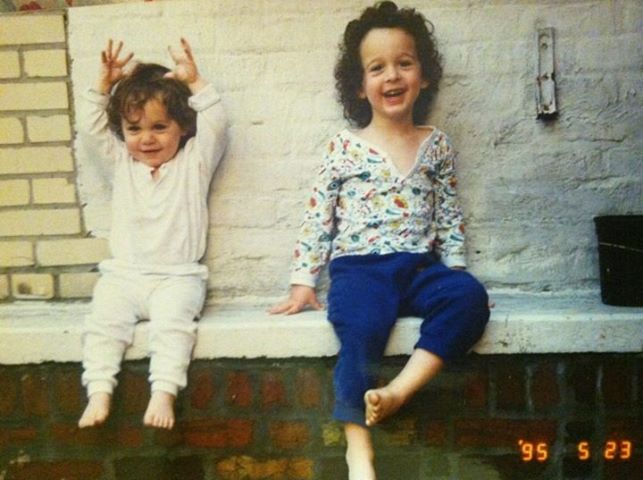
Natalie, almost 2, and Philip, 4
This is what our children give us. And no matter what, it’s with us always. Enjoy them; I know I did.
Death is Peace?
04 Dec 2013 35 Comments
in Death, Faith Tags: bereavement, death, death of a child, faith, grief, grieving, loss, loss of a child
“There’s a risk in thinking death is peace.”
A Course in Miracles
Another solution shot to shit. Because it’s an illusion; whatever I “look” to to take away what I’m suffering is an illusion. There isn’t a “future” answer. Whatever happens is created by what I do now. So what do I want? What kind of life do I want to live?
To lose my son; how can I ask what kind of life I want to live when I am not always sure I want to live it?
But then Thanksgiving comes. When it’s time to go home, I sit in my brother’s TV room with my coat on, waiting for Natalie to get ready. Someone is flicking the channels, someone stops at the football game. I see Jerseys full of numbers; I want a number, I say to Philip. I see a 20 on a player’s back. Not good enough, I say. I want 21. I look at the top of the screen. The score: 21-14.
Driving home, I am stunned to see myself surrounded by four cars with 20, 21, 22, and 201 all around me, and in that order. My God, I thought; he’s carrying me. I bob and weave through the traffic, and when I get off at my exit, the same car with 201 is in front of me. 201 turns left like I do. But when 201 gets to the light, he turns left again and goes back on the parkway, heading in the opposite direction.
Natalie works at the Short Hills Mall. On Saturday, I go to meet her. It’s mobbed, of course. Philip, I say, help me find a spot. I got it, he says. I head toward where I always park, and he says to go further. I’m creeping along trying to look down the aisles, when a young man steps out in front of me and I brake. So sorry, I say. He nods. I look to my left and there’s a car pulling out. I take the spot, and the car that I’m facing has 201 on its license plate.
If Philip could knock me over the head and say, “Cut it out,” he would. And he is, but in his own way. And I am fighting like a crazed caged tiger because I WANT HIM HERE. I want him here. Today my knees almost buckled when grief whacked me from behind. That horrendous moment when it all crystallized and I knew he was dead, 201s and all.
I am losing everything I thought I could escape to. Starving myself, withdrawing, flogging myself, wishing for death, as if I know what I’m even asking for when I say that. If I can’t handle the changes in my own life, how do I think I’m going to meet Death when He holds his hand out? Philip said to me that I will die the way I live. If I live in fear, that’s how I die. It’s not a punishment, just a statement of fact. That’s what I mean about what I do right now is creating my life. I think each change that comes is practice for death. Each change requires a leap of faith because even if I want that change, there’s always some fear and holding back, some reason why I think I shouldn’t be doing what I’m doing.
But what about something like this. What about the day Natalie says, “Mom, I got my own place.” It’s true I would be bursting with pride because she’s growing and taking steps to take care of herself, to become just that more independent. But I’ve still got that black space that Philip’s asked me to put that diamond in, and it’s full of bile it’s ready to spew all over me. When Natalie leaves, I can go on about how alone and miserable I am and now both of my kids are gone and what the hell is the point of being here and on and on. That comes from fear; and if I go through that kind of change with that kind of misery, if I’m thinking death is the only way out, I’m going to be shocked and terrified when it really does come because it’s the last and biggest change I will ever make. So will I meet it with grace and faith, or will fly out of here in a tornado of terror and fury?
I don’t know what the hell death is, but I am sure it isn’t the way I imagine it. When I say, “I want to die,” what I mean is I don’t want to feel. I wrote a while ago about the night I was driving, right after Philip died, thinking, “That’s it. I’m done. I don’t know how I’m going to do it, but I’m going to do it.” And I heard Philip say, “Mom you have to find the joy, it doesn’t work that way.” I understood him to mean that death changes nothing. Whatever I’ve got to work out, I’ve got to work it out where I am.
Thing is, I don’t have the other way. If I’m to give up all the self-destructive ways I handle Philip’s death, the things I do over and over, expecting different results, what do I replace them with? How do I talk to myself differently, and then actually believe what I say?
It’s been rough; it’s the holidays. A mood comes on. There’s nowhere to go. Philip’s birthday’s in January, he died in February. His absence grows stronger, much as I feel his presence. He’s always on my mind, but I don’t talk about any of this except here. And lately I understand the meaning of, “I Have No Mouth and I Must Scream.”
© 2013 Denise Smyth
To all of you…
28 Nov 2013 25 Comments
in Death, Faith Tags: bereavement, death, death of a child, faith, grief, grieving, loss, loss of a child
This is a day when many think about gratitude, but what I’m more thinking of now is forgiveness and perception. Because these are the portals to gratitude, and these are what I’ll be writing about next.
But not today. Today I just want to say that I do know what I have to be grateful for. First for my children; Natalie, who’s teaching me how to keep it real, and Philip, who’s teaching me to see it differently. And for all of you who’ve been helping me through his death. Because even though I’ve become one of the walking wounded, I don’t walk this way alone. I’m sorry for those I’ve joined, and for those who’ve come after. I want to say, “No one should go through this.” But it’s not for me to make that judgment. All I know is that this is where we are, and it’s what we mean to each other that’ll help get us through.
And today I’m wishing peace to all of you, even if it seems a distant dream. Because whatever short moments I’ve found of it these last months, it’s had much to do with all of you.
xoxoxoxoxo
© 2013 Denise Smyth
It’s Time
10 Nov 2013 22 Comments
in Death, Faith, Motherhood Tags: #WPLongform, addiction, bereavement, death, death of a child, faith, grief, grieving, loss of a child, motherhood, spirituality
I’m not so sure about choice. I don’t mean like what boots best go with my jeans or whether I want scrambled or over-easy. I mean choice about the way I feel or the way I think or even – which seems the most controllable – the way I act.
I don’t have much choice about what I think, but I can choose to look at it and distance myself from it, or dive into its darkly deep and believe it’s the truth of it all. And lately I’m bad as I’ve been, nursing my secrets as gently, carefully and constantly as I did my kids when they needed me.
I think I’m depressed, which is not the same as sad. Sad is being protective of my mournful heart. Depressed is anger I won’t feel; it’s me crying and hopeless and lying on the couch and not writing and doing all sorts of things with food that sooner or later I’ll have to talk about. “You have to take care of yourself,” my therapist tells me. “That’s why you feel like this. You’re angry; and you think you’re angry at yourself, but I think you’re angry at Philip.”
I’m not going to argue, but if I am angry at him, I don’t feel it. I’ve said before that Philip was involved with something bigger than he was and he didn’t get out of it before it got him. Look, I know addiction. I know the pull of alcohol, the craving for drugs, the sheer insistence that being Out of Mind and so Disconnected From Body has got to be better than this. So what I see is my child vulnerable, and how can I be angry at him for his weakness?
I know emotions don’t always make sense. Look at how angry I am at myself because Philip died – what the hell sense does that make? I’ve conflicting emotions all the time – what would be so strange about being grieved that Philip died, as well as angry at him because he did?
But what is it I value? I think I value suffering. I think I value being apart-from, living in a world I won’t let touch me. Which is what I mean about choice. Am I really choosing this? I’m not talking about Philip dying or how-of-course I’m grieved and somewhat unmoored. I’m talking about the particular way I’m suffering and the way it’s so easy to sacrifice myself to it. The way I can’t stay connected – to Philip, to Natalie, to Ed, to you all, to writing – which only means I can’t stay connected to my-self. And so I’m asking again; is this a choice I’m making??
Last week, I had another of my extraordinaries. A week ago Friday, actually. I’d been so down and withdrawn that maybe I scared myself, but whatever it was, something nudged me into getting in touch with Harriet, who I love very much and who’s seriously good for my soul.
We decided to have dinner at her apartment on Friday, which meant me picking up Greek food from the tiny Greek takeout in town. I went there to order, and while I waited, went next door to my dry cleaner to pick up some pants I’d had hemmed. My dry cleaner – whose name, after all these years, I still don’t know – is always happy to see me, but this time all her big smile did was make me burst into tears and when she came round the counter to hug me, it hit me how long it’d been since someone did.
Back outside, I sat at one of the small, curbside tables the Greeks put out when the weather allows, closed my eyes and tried to relax, listening, as always, for Philip. When I opened my eyes I looked up, and caught the sun lighting up some cotton-ball clouds into shades of golden red. Look at the clouds, Philip said. Watch.
So I stared, trying hard to make cloud shapes that looked like Philip. Am I going to see you, I asked? Am I going to see your fencing sword so I know for sure it’s you??
Just look and don’t try to see, he said; and what immediately popped up was a wolf’s head. Which I stared at and which appeared to be moving because clouds really are moving and because if you stare hard enough at anything it’ll seem to start moving. And this wolf had its mouth open, sometimes looking snarly and sometimes not. Then I saw a hand appear in front of its head, palm up. And then something swirling on this hand, something trying to take shape. Are you giving me something, I asked Philip? Are you giving me a gift?
And yes he was, because the thing swirled itself into a huge, red diamond shot through with light, perfectly balanced in the palm of this hand and I asked, are you giving me a diamond and he said yes, I am. You always say I’m the light. Now I’m giving you the light and I want you to take this diamond and put it in the dark spot where your heart is, because it’s time, mom. It’s time. And before I could fully grasp the thing he was telling me, a car pulled into the spot in front of me and had his initials on its license plate.
I swore I wasn’t going to tell this story. But I did. First to Harriet, and then to Ed. Ed’s the most realistic man I know but has yet to shrug off anything I tell him Philip says because Ed can hear its wisdom. Do you know what this story means, he asked and yes, I thought I did except for the part I missed. It’s that part that Ed said was the reason I wouldn’t tell this story, because if I did, I’d be committed to what it meant. Because what Ed heard was Philip asking me to be his mother because he is not my father and I cannot depend on him as if he was, and the reason I refuse to live my life is that I insist the only way I can “keep” Philip is by going all helpless-little-girl-I-need-you on him and I’m afraid if I grow the fuck up my son will vanish and take his diamonds and license plates and 21s with him and then he will have left me twice.
It’s closing in on me; Philip saying, “it’s time,” and all the things he’s said before. Asking me what it means to be his mother, what it means to be responsible, what do I think it feels like to him to have to watch the way I suffer. Not that I suffer, but the way that I suffer. The way I bring it on and lose myself and refuse to take what’s offered me.
Like that diamond, the one that’s supposed to be in my heart.
© 2013 Denise Smyth
An Ordinary Miracle (Part Two)
03 Nov 2013 30 Comments
in Death, Faith, Motherhood Tags: #WPLongform, bereavement, death, death of a child, faith, grief, grieving, loss, loss of a child, motherhood, spirituality
A couple months after Philip died, a friend asked if I was interested in seeing a medium she knew, S. Since S. was recommended, I said yes. Before Philip died, I hadn’t been to a psychic in decades, not since the Famous Jeffrey, whom Stephanie and I had to get on a waiting list in order to meet. We finally got the call, and the visit went something like Jeffrey telling me I was going to have two children and me answering that I was pregnant with my second and him saying smugly, See? I told you and me not saying that no, actually, you didn’t tell me, you should’ve known I was pregnant, and with a waiting list months-long and a fee of one-hundred-and-fifty-(1993)-dollars, I expected precision.
After that, the fascination remained, but I refused to waste my money on it.
And much as I thought I was going to get myself in trouble seeing a medium so soon after Philip’s death, I went anyway. See, I thought a medium was like a telephone. Like it’d be, Hello, Philip? Medium here. Your Mom’s freakin’ out. Say something to her, will ya??
I called S. to make the appointment and she only asked for my first name. She didn’t want to know anything about me, didn’t even ask if there was a particular dead person I wanted to talk to. I hung up thinking maybe this’d be okay.
That day I’d say I was half out of my mind, except my mind was half gone already, gone somewhere far away, probably in search of my son. That day my anxiety exceeded the limits my meds could handle. I was all sped up with nowhere to go. My appointment was at seven. It was a ten minute ride which meant I’d leave 25 minutes early to get there so I could hurry up and wait. At 6:00 I took my dogs for a walk, hooking my glasses in the top of my shirt. I usually kept them on a chain around my neck, but it’d broken and I hadn’t replaced it. I needed glasses for reading, for shopping, for seeing the food on my plate that, since my son died, I wouldn’t eat anyway. I couldn’t use them for distance because if I did, the world became muddled and distorted. Kinda like it was anyway.
When I walked my dogs strictly for business (their business, that is), I took a right turn out the house, walked to the corner, crossed the street, and circled back home. That’s exactly what I did as quickly as I could, as if quicker would make 6:35 come any sooner. Once inside, I realized my glasses were gone. Goddamnit. I’ll be right back I snarled at the dogs, and stormed out of the house. Since I was already in the habit of asking Philip to help me find things, I said to him, Philip, I want my glasses. Help me find them so I know you’re here.
Twice I went round, but no glasses. Furious, crying hard tears, I headed back to the house cursing and cursing and I don’t curse much but when I’m feeling whacked and out-of-control I go all Brooklyn-Italian on myself (don’t let “Smyth” fool you). Like, what the fuck, fuck this, are you fuckin’ kiddin’ me and fuck you, him, it and her. I had no problem hurling it all at Philip. Fuck you Philip, what the fuck was that? I want my glasses and when I get to this fucking medium you better either tell me where they are or tell me you’re sorry you didn’t help me find them or whatever, but fuck you’d better say something about my glasses.
Or what? I’d kick his ass?
I knew I was in trouble at S.’s house when she put some goopy new-age chakra meditation on and asked me to close my eyes, put on the headphones and listen. Like I really wanted to hear the deep, dulcet tone of some Woman-Wiser-Than-Me telling me to let my orange chakra allow my abundance to be abundant and my yellow chakra to allow my self-worth to be worthy and my green chakra that should be red because it’s the bloody heart chakra to allow its lovepeacejoy to be all that and Lady, you’re off your rocker if you think love, peace and most particularly joy and I can stand to share the same room, never mind the same headphones. I sat for ten minutes crying noiselessly because I was embarrassed by my need.
When it was over, S took my headphones, nodding, and said, “I know. It’s beautiful, isn’t it?”
Which pretty much sums up the session. Because what followed was this really nice lady saying meaningless things to me about ghosts I didn’t know or barely recognized. Although it did seem like my mother-in-law was making a stink, but we hadn’t much gotten along, so what was that to me? When I finally asked if I could talk to the person I wanted to, S. said it doesn’t exactly work like that, except that when I helplessly added, “See, my son…” she got the picture.
She told me that when I walked into the room, an 8-year-old boy came in with me. But he wasn’t eight, I said, not asking her why she didn’t mention that earlier. They do that sometimes, come in at different ages, S said. I don’t know why.
Then what the hell am I paying you for?
Nothing else much resonated. She said Philip liked to garden and he liked to draw and that he kept mentioning Brad, none of which meant anything since the first two were just wrong and the third wasn’t anyone I knew or ever heard Philip mention. She also talked about the letter K, another thing meant nothing and has since come to mean something so okay, I’ll give her that.
I left there devastated, angry at S. for what I felt was her ineptitude, angry at Philip for not showing up, angry at myself for exposing myself to such a risk.
Next morning, I took my emotionally-hungover self out to walk the dogs again. As usual, I walked without seeing, letting the dogs lead, lost in the space where Philip used to be. But then it was like something knocked me on my ass and I stopped dead where I was, looked up at the sky, and said, “Philip, I want my fucking glasses. NOW.”
When I looked down, there they were. Right at my feet, right on the grass I was standing on.
I got it. I really got it. Which is why Part One of this story set the stage, the part about me needing someone to please tell me how to live and please help me find the life I was missing. Because what Philip was saying to me was, “Mom, you don’t need a medium to talk to me. You need faith and responsibility, and it’s up to you to choose it. And you know I’m talking about something larger, too. I’m talking about life. Your life.”
Wouldn’t you think me “getting it” would amount to more than just some understanding? That “getting it” would be more than idea? Because so far, it isn’t. So far, I’m feeling like a lost little girl, alone and cut off again. So far, I’m crying a lot and thinking it’s all too much.
But I have another thought about this – well, actually, a lot of thoughts. More on that next.
© 2013 Denise Smyth
What I’ll Accept
26 Oct 2013 12 Comments
in Death, Faith, Lonlieness, Motherhood Tags: #WPLongform, acceptance, bereavement, death, death of a child, faith, grief, grieving, loneliness, loss, loss of a child, love
“Accept whatever comes to you woven in the pattern of your destiny, for what could more aptly fit your needs?”
—–Marcus Aurelius
I’m still trying to write Part Two because I wrote Part One and I already posted something in-between, but I can’t quite get there because this is the story that wants to come out, and really, it can be An Ordinary Miracle in its own right.
And I’m wanting to write this because for whatever reason it was that came over me, I seized a box of photos from when my kids were little and so many years away from losing the innocence that’s their birthright, tore through them and picked out the cutest of the cute and took them to my therapist to show her.
“Here,” I said as I walked in. “Look. I don’t know why, but I had to show you.”
There should be a word for the kind of loneliness you’re left with when someone you love more than life – or maybe you love life because of them, or maybe you’re not so sure what you feel about life, but you do know they’re what makes it bearable – when that one you love is all of a sudden dead. Just…dead. One minute they’re here, then they’re not, and one year, eight months and three days later you still can’t believe it and no matter how much good you know they’ve helped you see even though they’re dead, you just don’t see how you’re going to go on much more without them.
“Signs” notwithstanding.
We moved to Montclair when Philip was seven and Natalie five. Phil and I had been looking for a house in nearby Verona, which was somewhat less expensive. But our realtor’s office was in Montclair and the more we drove through it, the more Montclair’s funky, artsy, hipster, stately atmosphere started to feel like home, and I began to wonder why we were driving away from the place I wanted to live instead of toward it.
So Phil and I decided to expand our search into Montclair, and two weeks later I did something I hadn’t once thought to do during the five months we’d been on the hunt. I opened the real estate section of The New York Times on Saturday morning and saw a “Cozy and Charming” house for Sale by Owner in Montclair at a price that made me think there must be something wrong with it. There were built-in corner cabinets in the dining room and I don’t know why that’s what they mentioned in the ad instead of the the huge backyard with the deck and the patio and the stand of six cedar trees that stood guard over the large plot of grass just beyond them. But corner cabinets worked for me. I’m a sucker for aged and charming and “built-in” anything.
I made an appointment to see it on Sunday. Even if “Cozy and Charming” turned out to be “Cramped and Confined,” at least we’d spend some time in Montclair.
So next day we went to see it with Philip, but without Natalie, who hated car rides and asked if she could stay with Grandma, promising she’d come to NJ when we bought a house and were really going to live there.
Montclair is a lovely, hilly, hip and shaggy-tree town. It has lots of parks and a 408-acre reservation that spans three towns. It has movie theaters that show Manhattan-movies and restaurants and shops that make weekend parking impossible. It has a museum and a university, an uptown, a downtown and even a town in the middle. There’s the diversity of the not-so-mini-mansion-rich and lower-east side poor. And it’s filled with artists and writers and journalists and actors. High-level creatives, the kind of people I imagined had something I didn’t but living among them felt right even if I wound up keeping mostly to myself anyway.
When we pulled up in front of the house, I did what I always did – got out of the car, looked up and down the block, stood for a moment and asked, How do I feel?? To my surprise, the answer was good. Like, really good. Like, I think I could wake up and come outside and be really-glad-I-live-here good.
You already know the end of the story – we bought the house. But more importantly, we bought a home.
I suspect most of the house-buying-and-selling-thing is a transaction of the kind Nadiya had to suffer. Where the realtors swoop in, take the soul out of the house and hussle you out the back door when the buyer’s coming in the front. So the people who are making one of the biggest decisions they’ll ever make in their lives don’t get to meet each other until maybe it’s all said and done. I don’t know how it got to be like that, but welcome to Real Estate 2013. Me? I got lucky. I got Sam and Gina.
Sam and Gina raised their two kids in that house, but with a third on the way, they needed more room. They didn’t want to leave as much as they felt they had to. But it was the home they’d spent years creating and no matter how many realtors called begging to sell it for them, they said no, we want to try to sell this ourselves.
(And as I found out later, one of those realtors was mine, who called Sam and Gina and said, “I know a couple this house is perfect for – and I can get them to pay you $25,000 more for it!”)
The house was smaller than what I’d imagined for us, but its advertised Charm-and-Cozy actually was Charm-and-Cozy. The yard was lovely, with a wooden swing set in one corner and and a shed that looked straight out of a farmhouse with red siding and white trim in the other. And when a bunny leapt past me as I stood outside contemplating all this, I knew this was my house.
And I suspect Sam and Gina thought the same when, sitting at their dining room table making our offer, the French Doors slid open and Philip walked in. He’d been in the yard playing with their five-year-old daughter. “Excuse me,” he said, addressing himself to Gina. “But the little girl went into the barn and I don’t know if she’s supposed to.”
No, she wasn’t supposed to, since what Philip meant by “the barn” was the shed in the corner with the lawn mower and paint cans and garden tools and bug spray and pretty much every parent’s toxic nightmare all stashed into one spot. Sam ran out to get her while Gina gushed her thanks to Philip. And on the way home in the car, I turned to Philip and said, “You know, if we get that house, it’s because of you.”
Which I did and do believe. Because when Sam called us that night to congratulate us, he also let us know they turned down a higher offer because Gina was firm that the house needed to have children, and I knew it was Philip she had on her mind.
I’m not immune to the what-ifs, but thank God I don’t take them seriously. It’s crossed my mind that, well, what-if we didn’t buy that house, what-if we’d moved to Verona instead, what-if we’d chosen a different school for Philip to go to. Except more than that is the way my past has been woven, the way one story overlaps with another and how I can’t unravel one thread without unraveling it all. And Philip has been so much a part of whatever’s recognizably mystical in my life that even though I hate that I have to accept that he’s dead, I’m willing to accept he’s not gone.
© 2013 Denise Smyth
Hey, buddy
19 Oct 2013 23 Comments
in Death, Faith, Motherhood Tags: #WPLongform, bereavement, death, death of a child, faith, grief, grieving, loss, loss of a child, motherhood, spirituality
I’m taking a detour, again; swerving past the post I’m in the middle of writing because something half-formed is on my mind and I need to give some sort of shape to it. Because I’m trying to grasp some wisp of something that’s eluding me, something that’s solid about me and Philip because he’s not solid and the physical is easy, the physical we take for granted. Because I don’t talk much about him to the people whose lives he was part of, and they’re going about their business and I don’t know if they’re forgetting. And right now, it’s words that keep him real.
The couple I work for, Jack and Maggie, have two kids, a boy and a girl, in college. Yesterday, their son stopped in the office. A few minutes later, Jack walked in and said, “Hey, buddy.” And there was a seismic shift in my reality that took hours to recover from. See, “hey buddy” is a guy-thing. It’s a dad-and-son thing. It’s a thing I’ve heard before from fathers and sons on the softball field and the soccer field and at fencing tournaments and wherever I happened to be when I caught that moment of most generous affection some dad shot his son. And most of all, it’s a thing I heard between Phil and Philip.
Grief is insidious and unpredictable. It makes use of anything – an unintended glance at a picture I’ve looked a thousand times, the sleeve of a certain leather jacket sticking out in the closet, two little words from a time that doesn’t exist anymore. For hours I was closed and stung and pissy and weepy. Then, in an odd and directed way, there it was – 201. And the pieces shifted into place, but yet another different place. Because what hit me was that for those few hours I’d forgotten that I have a relationship with my son, the way Jack and Maggie have a relationship with theirs. That I don’t have to accept that Philip’s dead, but I do have to accept my grief because he’s dead. It’s not what I want, but it’s what I have. And as I said to Lucia, I’m not in the world in the same way, and when I forget that, I get myself into trouble.
I was commenting on a post by afichereader at somenewnormal (who is a lovely, elegant and serious writer) and I’d said that there is only, ever, Now. Which got me to remembering that I can’t solve an imaginary problem in some neurotic future I’ve invented. I can only solve a problem where I am. The future, when it “comes,” only ever comes as Now. Which doesn’t mean I don’t plan – but planning and projecting are two different things. If I save money every month because I might need it down the road, that’s planning. If I sit here and chew my nails because I’m alone and I don’t think I’ll have money when I get too old to work and what’s going to happen because Natalie’s not going to want me to live with her and what happens when you can’t afford to pay your rent or buy food or pay your car insurance and you have nowhere to put your clothes and your computer breaks and you can’t get another one and…
Whew. I don’t know about you, but I need a breath.
Worrying, suffering, sorrow, require Time. I’m not talking about clock time – that’s for showing up where you’re supposed to show up when you’re supposed to be there. Or for sitting your ass in front of the TV because Breaking Bad’s about to premiere. I’m talking about past-and-future. Which I’ve also heard called, “psychological time.” I’m talking about the mental trips we take to places we’ve been or places we imagine and by “places” I mean situations, I mean scripts we write and stories we tell ourselves and all the misery we create while we’re at it. Think about it. When do you worry about what you’re doing when you’re doing it? If you say, well, here I am baking this cake and I’m worrying about it right now because it’s for my friend’s party and I want it to be like, the best cake ever, or at least better than anyone else’s cake but what if it’s not so good and nobody likes it and they all know I’m the one who made it, what then?
So you’re not worrying about the present, not at all. You’re worried because you’re already at that party with a crummy-no-pun-intended cake and you’re all embarrassed and such. You’re not really there while you’re whipping that butter and sugar into airy goodness and adding eggs and flour and vanilla and what-all-else to make a creamy, luscious batter that yeah, you stick your finger into even though you said you wouldn’t and when the cake is in the oven you get to lick all that creamy goodness off the beater because there aren’t any more kids at home you have to give it to first.
I know this. I know this because paying to attention to Now was my work when Philip died. It’s not something I did once, it’s not something I just got the hang of. It’s practice, and far as I can tell it’s the practice of making peace. Having peace. Because if I sit here paying attention to this hot cup of tea I’m sipping, I’m not thinking past/future and all the heartache and misery I bring along with it.
Right after Philip died, I told my sister-in-law Joan that I was terrified to live. That years and years and years were going to go by and I cannot do this without Philip because I will turn into a sick, wretched old woman who’s lost her mind because she lost her son. What is there for me, what the fuck is there?
You won’t, she said; I know you won’t. And she told me about an elderly woman, a patient in the dental office she works in, who carries around her son’s obituary. Every time she comes in, Joan said, she talks about her son and pulls out the obituary. And all I could think was, Obituary?? Philip has an obituary?? Where is it, who put it there, who wrote it? He can’t have an obituary, that’s for people who are really dead; for ghosts, people who have names and families but don’t exist except as names on the paper they’re printed on. Philip can’t have an obituary because he had flesh and blood that came from my flesh and blood and what does it mean to be ink on a page that someone will glance at and not even notice?
I am that old woman, I cried to Joan; she is me.
See, I recognize her, and she scares me. She went down the hole I stand on the brink of, which is not the same as the void that Philip left me. One’s where you go when you give up, the other where you go when you find the courage to do so. And I’m not going to say I don’t know which way I’m going because I know the choice I made. Thing is, I can’t go without bringing that old woman with me.
© 2013 Denise Smyth

 Forever 21